Why Manufacturers Using Dynamics GP Are Hesitant to Move to Business Central
Dynamics GP Has Been the Backbone of Manufacturing Operations for Years
For many manufacturers, Dynamics GP is far more than an accounting system. It supports critical business functions, including inventory management, procurement, production planning, cost accounting, warehouse operations, and financial management.
Over the years, and often decades, manufacturers have customized Dynamics GP to reflect the realities of their operations. Processes have been refined, integrations have been built, and teams have developed workflows that rely heavily on the system.
This deep operational integration explains why manufacturers often approach a Dynamics GP to Business Central migration differently than other organizations.
While distributors, professional services firms, and other Dynamics GP customers may see a relatively straightforward path to modernization, manufacturers face a more complex reality. Their ERP environments are often tightly connected to production processes, supply chains, inventory management, and operational performance.
As Microsoft continues investing in cloud-based ERP innovation through Dynamics 365 Business Central, manufacturing leaders are increasingly evaluating what that shift means for their organizations.
The challenge is not determining whether Dynamics GP still works today.
For most manufacturers, it does.
The real question is whether it will continue to support the business objectives, technology initiatives, and competitive requirements that will define success over the next decade.
Table of Contents
Why Are Manufacturers More Hesitant Than Other GP Customers to Move to Business Central?
What Does Microsoft's Dynamics GP Roadmap Mean for Manufacturing Companies?
Can Manufacturers Stay on GP Safely, and for How Long?
What Are the Biggest Risks of Delaying ERP Modernization?
How Should Manufacturers Evaluate Hosted GP Versus Business Central?
Should Manufacturers Move from Dynamics GP to Business Central?
Frequently Asked Questions
Why Are Manufacturers More Hesitant Than Other GP Customers to Move to Business Central?
Having spent time in manufacturing environments myself, I've learned that ERP decisions are rarely technology decisions. They're production decisions. Every change gets evaluated through the lens of operational continuity.
Unlike businesses that primarily rely on ERP systems for financial management, manufacturers depend on ERP platforms to support:
- Production planning and scheduling
- Bills of materials (BOMs)
- Routings and work centers
- Inventory and warehouse management
- Cost accounting
- Quality management processes
- Procurement and supply chain coordination
- Shop floor operations
Over time, many manufacturers have invested heavily in customizations and third-party solutions that extend Dynamics GP beyond its original capabilities.
As a result, one question consistently arises:
Will Business Central support the way we run our business today?
This concern is valid.
A manufacturing ERP system is rarely just software. It represents years of operational knowledge, process optimization, and institutional expertise.
I recently spoke with a manufacturer whose scheduling process depended on a series of custom GP workflows that had evolved over more than a decade.
Their concern wasn't whether Business Central could replace Dynamics GP.
Their concern was whether it could support the operational habits, planning processes, and production routines the business had built around it.
That's a common theme in manufacturing. ERP systems often become deeply embedded in day-to-day operations, making modernization as much an operational decision as a technology decision.
Manufacturing executives often worry that modernization could require:
- Rebuilding critical integrations
- Replacing customized functionality
- Retraining users
- Disrupting production workflows
- Introducing unnecessary operational risk
For manufacturers, hesitation is not about resisting change.
It is about protecting operational continuity while preparing for the future.
What Does Microsoft’s Dynamics GP Roadmap Mean for Manufacturing Companies?
One reason ERP modernization discussions have become more urgent is Microsoft’s continued focus on cloud-first business applications.
While Dynamics GP remains supported, Microsoft’s innovation investments are increasingly concentrated on Dynamics 365 Business Central, Power Platform, Microsoft Fabric, Copilot, and the broader Microsoft cloud ecosystem.
Understanding the Microsoft Dynamics GP roadmap is now a critical component of long-term ERP planning.
This distinction is important because support and innovation are not the same thing.
An ERP platform can remain fully supported while gradually becoming disconnected from emerging technologies and modern business capabilities.
Manufacturers evaluating their long-term ERP strategy should therefore consider more than support timelines. They should evaluate how future initiatives align with Microsoft’s technology roadmap.
Key considerations include:
Talent Availability
As fewer organizations implement new Dynamics GP systems, experienced GP consultants, developers, and administrators may become increasingly difficult to find.
Technology Integration
Modern Microsoft technologies, including AI-powered Copilot capabilities, Power BI, Power Automate, and cloud services, are increasingly optimized for Business Central.
Microsoft’s manufacturing technology strategy also emphasizes AI, industrial data integration, automation, and connected operations delivered through cloud platforms.
Software Ecosystem Evolution
Many ISVs and technology vendors are directing product development toward cloud ERP environments rather than traditional on-premises systems.
Long-Term Strategic Planning
Manufacturers making ERP decisions today must consider where the business will be in five to ten years, not simply where it is today.
The Microsoft Dynamics GP roadmap provides continued support for existing customers while clearly signaling Microsoft’s long-term direction toward cloud ERP innovation.
The question is no longer whether Dynamics GP can support current operations.
The question is whether it can support future transformation initiatives as effectively as modern cloud ERP platforms.
Can Manufacturers Stay on GP Safely, and for How Long?
For many organizations, the answer is yes.
A stable Dynamics GP environment can continue operating successfully for years when properly maintained and supported.
However, the long-term viability of remaining on GP depends on several factors.
Infrastructure Readiness
Organizations with secure, well-maintained infrastructure may have greater flexibility in determining modernization timelines.
Customization Complexity
Highly customized environments often require careful evaluation to ensure long-term maintainability and supportability.
Regulatory Requirements
Manufacturers operating in highly regulated industries may face evolving compliance and cybersecurity requirements that influence technology decisions.
Growth Objectives
Companies pursuing acquisitions, expansion, automation, advanced analytics, or digital transformation initiatives may encounter limitations sooner than organizations focused primarily on maintaining existing operations.
The risk is not that Dynamics GP will suddenly stop functioning.
While Microsoft has not announced an immediate Dynamics GP end-of-life, manufacturers should recognize that support timelines and innovation roadmaps are distinct considerations.
The larger concern is whether remaining on GP continues to align with the organization’s long-term strategic goals.
What Are the Biggest Risks of Delaying ERP Modernization?
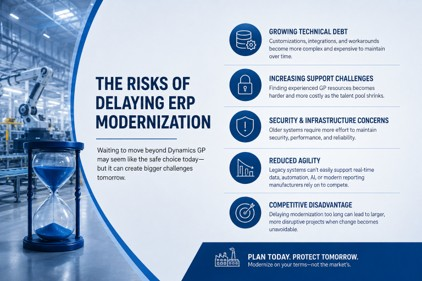
Many organizations assume that delaying ERP modernization reduces risk.
In reality, postponing modernization often shifts risk rather than eliminating it.
Several challenges tend to increase over time.
Growing Technical Debt
During a recent ERP assessment, a leadership team came to an important realization.
Their biggest challenge wasn't Dynamics GP itself.
It was the growing number of spreadsheets, manual workarounds, disconnected applications, and shadow processes that had developed around the ERP system over time.
In many cases, technical debt isn't created by the ERP platform alone. It's the result of years of incremental fixes designed to compensate for evolving business requirements.
Years of customizations, integrations, and workarounds create complexity that becomes increasingly difficult and expensive to maintain.
As technical debt grows, organizations often spend more time maintaining legacy processes and less time investing in innovation.
Increasing Support Challenges
As the pool of experienced Dynamics GP resources shrinks, maintaining specialized environments may require greater investment.
Security and Infrastructure Demands
Older systems often require additional effort to maintain modern security, reliability, and performance standards.
Reduced Agility
Today’s manufacturers increasingly rely on:
- Real-time analytics
- Cloud collaboration
- Process automation
- AI-driven insights
- Connected business applications
Legacy environments can make these initiatives more difficult to implement and scale.
Competitive Pressure
Organizations that postpone ERP modernization for manufacturers for too long often face larger, more disruptive projects later when change becomes unavoidable.
The objective is not modernization for its own sake.
The objective is to reduce risk, increase agility, and position the business for future growth.
How Should Manufacturers Evaluate Hosted GP Versus Business Central?
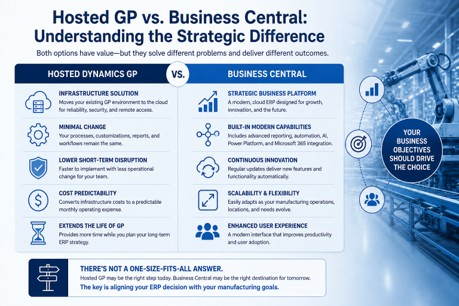
One of the most important decisions manufacturers face today is whether to move Dynamics GP to a hosted environment or migrate to Business Central.
Although these options are often discussed together, they solve different business challenges.
Hosted GP
Hosted GP moves an existing Dynamics GP environment to cloud infrastructure while preserving the current application.
Benefits often include:
- Reduced on-premises infrastructure management
- Improved remote accessibility
- Enhanced disaster recovery
- Extended life of existing investments
- Lower short-term disruption
For organizations seeking operational continuity, hosted GP can be an attractive option.
One CFO described hosted GP to me as "buying time." The organization wasn't ready for a full ERP transformation, but it needed to address aging infrastructure, improve remote accessibility, and reduce the burden of maintaining on-premises systems.
That perspective highlights an important distinction.
Hosted GP can solve infrastructure challenges relatively quickly, but it does not necessarily address the broader modernization opportunities many manufacturers are evaluating.
However, it is important to recognize that hosted GP is primarily an infrastructure strategy, not necessarily a Dynamics GP migration strategy.
The underlying ERP platform remains Dynamics GP.
Business Central
Business Central represents a broader transformation of the ERP platform itself.
Potential benefits include:
- Continuous cloud updates
- Modern user experience
- Native Microsoft ecosystem integration
- Advanced reporting and analytics
- Greater scalability
- Access to AI-enabled capabilities
Many executives evaluating Business Central manufacturing capabilities are also looking for stronger analytics, improved automation, and greater flexibility to support future growth.
However, achieving these benefits typically requires more organizational change, planning, and process evaluation.
The Strategic Question
Rather than asking:
“Which option is less expensive?”
Manufacturing leaders should ask:
“Which option best supports our business goals over the next five to ten years?”
For some organizations, hosted GP may provide an effective transitional strategy.
For others, a Dynamics GP-to-Business Central strategy for manufacturers may offer a stronger long-term foundation for growth and innovation.
The right answer depends on operational requirements, business objectives, risk tolerance, budget, and organizational readiness.
Should Manufacturers Move from Dynamics GP to Business Central?
There is no universal answer.
Some manufacturers are excellent candidates for Business Central today.
Others may benefit from a phased modernization approach that includes hosted GP, infrastructure improvements, process optimization, or organizational preparation before a full ERP migration.
The most successful ERP initiatives begin with business strategy, not software selection.
Manufacturing leaders should evaluate:
- Current operational challenges
- Future growth plans
- Technology roadmap requirements
- Existing customizations
- Integration dependencies
- Internal resource availability
- Change management readiness
The goal is not simply to replace Dynamics GP.
The goal is to establish an ERP foundation that supports long-term business success.
When approached strategically, a Dynamics GP-to-Business Central initiative for manufacturers becomes less about software replacement and more about enabling business transformation.
The Bottom Line
Manufacturers have legitimate reasons to approach ERP modernization cautiously.
Their environments are more complex, their operational risks are higher, and the consequences of disruption can be significant.
However, delaying the conversation indefinitely is not a strategy.
Microsoft’s ERP roadmap, evolving technology expectations, increasing technical debt, and growing competitive pressures are prompting manufacturers to evaluate their options more carefully than ever.
Whether the path forward involves hosted Dynamics GP, Business Central manufacturing solutions, or a phased ERP modernization strategy for manufacturers, the most important step is understanding the business implications before making a technology decision.
Organizations that begin planning today will have far more flexibility than those forced to react later.
Ready to Evaluate Your ERP Future?
If you’re currently running Dynamics GP and wondering what your next move should be, start with a strategic assessment rather than a software demo.
At Liberty Grove Software, we help manufacturers evaluate their ERP landscape, understand modernization risks, and build practical roadmaps that align technology decisions with business goals.
Schedule a Dynamics GP Modernization Assessment with Liberty Grove Software and gain a clear understanding of your options, risks, and opportunities before making your next ERP decision.
Frequently Asked Questions
Is Dynamics GP being discontinued?
Microsoft continues to support Dynamics GP and provide updates. However, Microsoft’s primary ERP innovation investments are focused on Dynamics 365 Business Central and cloud-based technologies.
What is replacing Dynamics GP?
For most small and mid-sized organizations, Dynamics 365 Business Central is considered Microsoft’s strategic successor ERP platform.
Should manufacturers move from GP to Business Central?
It depends on operational complexity, existing customizations, growth plans, and modernization goals. Every manufacturer should conduct a strategic assessment before making a migration decision.
Can Business Central handle manufacturing?
Yes. Business Central includes native manufacturing functionality and supports make-to-stock, make-to-order, and other production processes. The suitability depends on operational complexity and specific business requirements.
Is Business Central better than Dynamics GP?
Neither platform is universally better. The right choice depends on business goals, technology strategy, scalability requirements, and future growth plans.
How difficult is it to migrate from GP to Business Central?
Migration complexity varies based on customizations, integrations, manufacturing processes, data quality, and organizational readiness. Proper planning significantly reduces risk.
Can I move GP to the cloud without moving to Business Central?
Yes. Hosted GP environments allow organizations to gain the benefits of cloud infrastructure while continuing to use Dynamics GP.
What are the biggest ERP migration risks for manufacturers?
The most common risks include inadequate planning, unsupported customizations, integration challenges, operational disruption, user adoption issues, and insufficient change management.
Coming Next in This Series
Can Business Central Really Handle Manufacturing Complexity?
One of the most common concerns among manufacturing leaders is whether Business Central's manufacturing capabilities can support complex production environments.
In the next article, we’ll examine:
- Manufacturing functionality in Business Central
- Production orders, routings, and BOM management
- Make-to-stock and make-to-order capabilities
- Inventory visibility and planning tools
- When third-party manufacturing solutions may be required
We’ll also explore:
- The Real Fear Behind Leaving Dynamics GP in Manufacturing
- Why Manufacturing Customizations and ISVs Become ERP Migration Roadblocks
- Cost Accounting Differences Between GP and Business Central
- Hosted GP vs Business Central: What Manufacturers Need to Consider
Together, these articles will help manufacturers build a practical roadmap for ERP modernization and make informed decisions about their long-term technology strategy.
About Andrew Good

Andrew Good, CEO, Liberty Grove Software
Andrew Good, CEO of Liberty Grove Software, a leader in digital transformation, directs the company with strategic insights that deliver impactful results. With over two decades of expertise in Microsoft technologies, Andrew has guided businesses through digital transformation across manufacturing, finance, and healthcare.
Andrew's extensive knowledge comes from personal experiences with various companies. His hands-on operational knowledge comes from Engineering, Maintenance, and operational roles at Unilever and Sony Music. Fourteen years of working with Microsoft Dynamics BC/NAV follows successful projects in ERP, Computerized Maintenance Management Systems (EAM), and quality systems.
His passion for technology is matched by his love for sailing, which inspires his leadership. Andrew parallels the precision of navigating the seas and the challenges of steering a successful company. Under his leadership, Liberty Grove Software thrives, offering tailored solutions to empower clients and optimize operations with innovative Microsoft-based systems.