When manufacturers begin evaluating a move from Dynamics GP to Business Central, the conversation usually starts with software.
- Can Business Central handle our manufacturing requirements?
- Will it support our production processes?
- What about production planning, inventory control, shop floor operations, scheduling, quality management, engineering change management, inventory costing, and operational reporting.
Those are important questions.
But after years of helping manufacturers modernize ERP systems, I’ve found that the biggest data migration risks rarely come from Business Central.
They come from years of undocumented decisions, forgotten integrations, custom reports, third-party applications, and business processes nobody realized the company still depended on.
Many executives assume they’re replacing an ERP system.
In reality, they’re often replacing an ecosystem.
And that distinction changes everything.
“One of the biggest surprises manufacturers encounter during ERP modernization is realizing they’re not dependent on Dynamics GP. They’re dependent on everything that’s been built around it. Before you can plan where you’re going, you need to understand what your business actually relies on today.” — Andrew Good, CEO, Liberty Grove Software
I’ve worked with manufacturers who believed they had a straightforward Dynamics GP migration ahead of them. Once we began assessing the environment, we discovered dozens of customizations, multiple GP ISV solutions, legacy integrations, spreadsheets supporting critical processes, and business logic that had evolved over fifteen years.
The software wasn’t the obstacle.
The complexity surrounding it was.
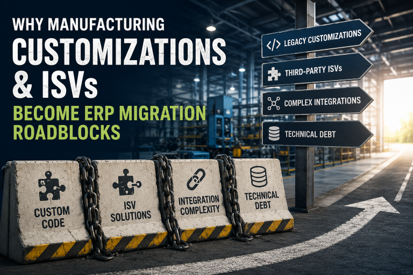
That’s why manufacturing customizations and ISV dependencies frequently become the biggest roadblocks in ERP migrations.
Not because they’re inherently bad.
But because most organizations don’t fully understand how deeply embedded they have become.
Table of Contents
The Dependency Trap Most Manufacturers Don’t See Coming
Why Dynamics GP Customizations Become Migration Roadblocks
Executive Insight: Complexity Is Not the Same as Competitive Advantage
Why GP ISV Solutions Frequently Delay ERP Modernization
The Hidden Risk of Dynamics GP Integrations
ERP Technical Debt Is a Business Problem, Not an IT Problem
Should Manufacturers Recreate Every Customization in Business Central?
A Practical Framework for Evaluating Customizations and ISVs
The ERP Modernization Opportunity Most Manufacturers Miss
A Story I See Repeatedly
A Final Thought
Ready to Understand Your ERP Environment?
Frequently Asked Questions
The Dependency Trap Most Manufacturers Don’t See Coming
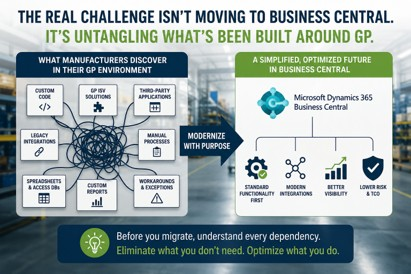
ERP modernization should focus on preserving business value, not preserving complexity. Manufacturers that evaluate customizations, ISVs, integrations, and manual processes individually often discover opportunities to simplify their future ERP environment.
One of the most common discoveries during an ERP assessment is that manufacturers are not actually dependent on Dynamics GP.
They’re dependent on everything surrounding Dynamics GP.
The ERP system becomes the hub.
Customizations become the spokes.
Third-party applications fill functionality gaps.
Integrations connect operational systems.
Manual processes compensate for historical limitations.
Over time, these solutions become part of how the business operates.
Nobody questions them.
Nobody documents them.
Nobody evaluates whether they are still necessary.
Then modernization begins.
Leadership starts discussing timelines, budgets, and implementation strategies.
Suddenly, a simple question emerges:
“What happens to everything we’ve built around GP?”
That is often when project complexity increases dramatically.
“One of the most valuable outcomes of an ERP assessment isn’t identifying what needs to be migrated. It’s identifying what doesn’t. The goal of modernization isn’t to preserve complexity. It’s to determine which processes still create value and which ones are simply creating maintenance.” — Andrew Good, CEO, Liberty Grove Software
Why Dynamics GP Customizations Become Migration Roadblocks
Most Dynamics GP customizations were created for legitimate business reasons.
A production process required additional functionality.
A customer demanded a unique workflow.
A reporting gap needed to be addressed.
An operational challenge required a workaround.
Individually, these decisions made sense.
Collectively, they often create a modernization challenge.
The issue is not the customization itself.
The issue is understanding what depends on it.
I’ve seen manufacturers discover that a customization originally created to support a customer-specific production workflow was connected to inventory transactions, production orders, reporting systems, warehouse operations, and shipping processes.
On paper, it appeared to be a simple modification.
In reality, it impacted multiple departments and several business-critical processes.
That’s the type of dependency that often surprises organizations during ERP modernization.
It has become part of the organization’s operating model.
The challenge isn’t rebuilding the customization.
The challenge is understanding what breaks if you don’t.
That is what transforms a customization into a migration roadblock.
Executive Insight: Complexity Is Not the Same as Competitive Advantage
One of the most common assumptions I hear from leadership teams is:
“We’ve customized GP because our business is unique.”
Sometimes that’s true.
Sometimes it isn’t.
I’ve seen manufacturers maintain custom functionality for years because it solved a problem that existed a decade ago.
The business evolved.
The technology evolved.
But the customization remained.
Over time, familiarity becomes mistaken for necessity.
One of the most valuable questions executives can ask during ERP modernization is:
If we were implementing an ERP system today, would we choose to build this customization again?
The answer often reveals opportunities to simplify rather than replicate.
Why GP ISV Solutions Frequently Delay ERP Modernization
For many manufacturers, the biggest surprise is not the number of customizations.
It’s the number of third-party solutions supporting critical business processes.
Over the years, organizations have added GP ISV solutions to address specific operational needs.
- Warehouse management
- EDI and supplier collaboration
- Quality management
- Advanced production scheduling
- Engineering change management
- Shop floor data collection
- Production reporting
- Product configuration management
Each solution solves a problem.
The challenge is that every solution introduces another dependency.
I’ve seen manufacturers delay ERP projects by months while trying to answer a simple question:
“What happens to all of our ISVs?”
Some GP ISV solutions have Business Central versions.
Some have modern alternatives.
Some are no longer actively developed.
Some have become so deeply embedded in operations that replacing them feels riskier than staying on GP.
At that point, the discussion shifts from software to business continuity.
That’s why early ISV assessments are crucial in any ERP modernization strategy, helping organizations identify potential delays and plan accordingly.
As manufacturers evaluate their long-term ERP strategy, it’s important to understand Microsoft’s ongoing support plans and product direction for Dynamics GP.
The Hidden Risk of Dynamics GP Integrations
Integrations are often where migration complexity becomes most apparent.
Most manufacturers have spent years connecting Dynamics GP to other operational systems.
Common examples include:
- Manufacturing Execution Systems (MES)
- Warehouse Management Systems (WMS)
- EDI platforms
- Shipping systems
- CRM applications
- Quality management software
- Product lifecycle management systems
- Business intelligence platforms
- CAD systems
- Engineering systems
- Product configuration tools
- Automated production equipment
Every integration serves a purpose.
The challenge is that many organizations lack full visibility into how their integrations function, risking operational disruptions during migration.
I’ve seen manufacturers discover undocumented integrations supporting critical processes.
I’ve also seen key integrations maintained by a single employee approaching retirement.
Those situations create risk that extends far beyond ERP migration.
They create operational dependency.
Before discussing future-state architecture, organizations need a clear understanding of their current environment, empowering IT managers to lead the migration with confidence and control.
ERP Technical Debt Is a Business Problem, Not an IT Problem
What Complexity Is Really Costing You
Most manufacturers understand that complexity creates challenges. What they often underestimate is the financial impact. Every customization, ISV dependency, integration, and manual workaround carries a cost that extends far beyond the IT department.
Consulting Costs
The more customized an ERP environment becomes, the more specialized expertise is required to maintain it. Organizations often find themselves dependent on consultants who understand legacy code, aging integrations, and custom business logic, increasing both support expenses and project costs.
Support Costs
Every customization and third-party solution introduces another component that must be monitored, maintained, tested, and supported. As environments become more complex, support requirements increase, consuming both internal resources and external support budgets.
Delayed Upgrades
Legacy customizations and ISV dependencies can make upgrades significantly more difficult. Manufacturers often postpone modernization initiatives because of concerns about what might break, creating a cycle in which aging technology becomes increasingly expensive and risky to maintain.
Lost Productivity
Complex ERP environments often rely on manual workarounds, spreadsheets, duplicate data entry, and undocumented processes. While these inefficiencies may seem minor individually, they can collectively consume hundreds of employee hours each year and reduce operational efficiency across the organization.
Cybersecurity Exposure
Unsupported customizations, outdated integrations, and aging third-party applications can create security vulnerabilities that are difficult to identify and remediate. As cyber threats continue to evolve, older ERP ecosystems often present a larger risk profile than many organizations realize.
Employee Dependency
Many manufacturers rely on a small number of long-tenured employees who understand how customizations, integrations, and manual processes work. When that knowledge resides with only a few individuals, employee turnover, retirement, or organizational change can create significant operational risk.
Industry Perspective
According to Gartner, technical debt represents the future cost organizations incur when short-term technology decisions create long-term complexity. For manufacturers, that complexity often appears in the form of legacy customizations, unsupported integrations, and aging third-party solutions that make ERP modernization more difficult.
The cumulative impact of these costs is often substantial. What appears to be a stable ERP environment may actually be limiting agility, increasing risk, and making future modernization efforts more expensive than necessary.
Technical debt is often treated as a technology issue.
Manufacturing executives should view it differently.
Technical debt impacts business agility.
It affects scalability.
It increases risk.
It slows decision-making.
For manufacturers pursuing growth through acquisitions, facility expansion, or new product lines, technical debt can become a significant barrier to scalability.
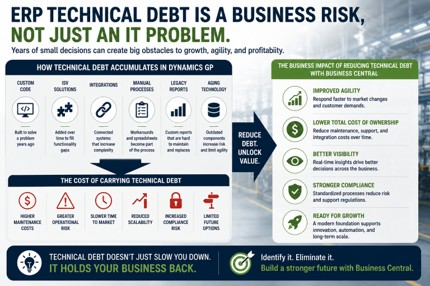
ERP technical debt accumulates over time through customizations, ISV dependencies, integrations, manual workarounds, and aging technology. While often viewed as an IT issue, technical debt ultimately impacts agility, scalability, profitability, compliance, and long-term business growth.
Over time, technical debt accumulates through:
- Legacy customizations
- Manual workarounds
- Spreadsheet-driven processes
- Unsupported integrations
- Aging ISV solutions
- Outdated reporting tools
Individually, each item seems manageable.
Collectively, they create a level of complexity that can significantly increase migration risk.
“Technical debt rarely appears all at once. It accumulates through years of reasonable decisions made to solve immediate business challenges. The problem isn’t that those decisions were wrong. The problem is that eventually complexity begins limiting growth, agility, and the organization’s ability to move forward.” — Andrew Good, CEO, Liberty Grove Software
One CFO recently described it perfectly:
“The software still works. What worries me is how much of the business depends on things nobody fully understands anymore.”
That’s the real issue.
Should Manufacturers Recreate Every Customization in Business Central?
In most cases, no.
One of the biggest mistakes manufacturers make is assuming modernization means rebuilding everything exactly as it exists today.
That approach often preserves complexity rather than eliminating it.
Modernization should be an opportunity to challenge assumptions.
Questions worth asking include:
- Does this customization still support the business?
- Does Business Central already provide this functionality?
- Is there a simpler way to achieve the same outcome?
- Is this process still relevant to future business goals?
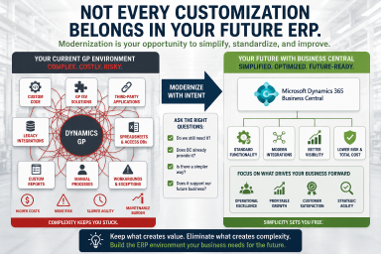
ERP modernization should focus on preserving business value, not preserving complexity. Manufacturers that evaluate customizations, ISVs, integrations, and manual processes individually often discover opportunities to simplify their future ERP environment.
I’ve seen manufacturers spend months planning how to recreate custom functionality only to discover Business Central already addressed the requirement through standard capabilities.
The goal should not be replication.
The goal should be optimization.
A Practical Framework for Evaluating Customizations and ISVs
I recommend that manufacturers classify every customization, ISV, and integration into one of three categories.
Strategic Differentiators
These directly support how the business competes.
Examples may include:
- Proprietary production processes
- Specialized manufacturing workflows
- Engineering-to-order requirements
- Product configuration capabilities
- Industry-specific compliance processes
Operational Enhancements
These improve efficiency but do not necessarily create a competitive advantage.
Examples include:
- Reporting improvements
- Workflow automation
- Productivity enhancements
Historical Artifacts
These exist because they have always existed.
They may no longer provide meaningful business value.
In many assessments, this category is larger than executives expect.
And it often represents the greatest opportunity for simplification.
In many cases, standard functionality available within Microsoft Dynamics 365 Business Central can replace custom solutions that were originally developed to address historical limitations.
Manufacturers are often surprised by how much functionality is now available through Business Central’s standard manufacturing capabilities.
The ERP Modernization Opportunity Most Manufacturers Miss
Many organizations approach ERP migration as a technology replacement project.
The most successful manufacturers approach it as a business simplification initiative.
Every customization.
Every ISV.
Every integration.
Every workaround.
Every manual process.
Should be evaluated through the lens of future business objectives.
The goal is not preserving complexity.
The goal is to reduce it.
Manufacturers that embrace this mindset often discover that modernization becomes less intimidating and significantly more valuable.
A Story I See Repeatedly
During a recent assessment, a manufacturer believed its production scheduling and warehouse management customization was mission-critical.
Once documented, the team discovered that most of the functionality was already available through modern Business Central capabilities.
What initially appeared to be a major migration obstacle became a simplification opportunity.
Leadership assumed every customization was mission-critical.
Every integration was essential.
Every ISV was irreplaceable.
Then we began documenting the environment.
What we discovered surprised everyone.
Several customizations solved problems that no longer existed.
Some integrations were no longer actively used.
A few ISV solutions had already been replaced by standard Business Central functionality.
Only a handful of dependencies were truly strategic.
The lesson wasn’t that customizations are bad.
The lesson was that visibility matters.
Most manufacturers don’t have a customization problem.
They have a visibility problem.
Until you understand why a customization exists, it’s impossible to determine whether it deserves a place in your future ERP environment.
“The manufacturers that navigate ERP modernization most successfully aren’t the ones with the fewest customizations or integrations. They’re the ones with the clearest understanding of why those dependencies exist and whether they still support the future business.” — Andrew Good, CEO, Liberty Grove Software
A Final Thought
After years of helping manufacturers modernize ERP systems, I’ve come to believe that customizations themselves are rarely the problem.
The real challenge is dependency.
Dependency creates risk.
Dependency increases cost.
Dependency slows modernization.
Dependency makes change feel more difficult than it often needs to be.
The manufacturers that achieve the best outcomes aren’t the ones with the fewest customizations.
They’re the ones that understand their environment well enough to make informed decisions about what belongs in the future and what should remain in the past.
Before asking how to migrate every customization, ask a different question:
Which of these dependencies still support our future business?
The answer may dramatically simplify your ERP modernization journey.
Ready to Understand Your ERP Environment?
Before committing to a Dynamics GP migration strategy, manufacturers need a clear understanding of the customizations, ISVs, integrations, and technical debt shaping their current environment.
Liberty Grove Software helps manufacturers identify hidden dependencies, evaluate modernization risks, and build practical ERP roadmaps that support long-term business goals.
If you’re considering a move from Dynamics GP to Microsoft Dynamics 365 Business Central, let’s start with a conversation.
Our team can help you:
- Assess Dynamics GP customizations
- Evaluate GP ISV solutions
- Identify integration risks
- Reduce ERP technical debt
- Develop a practical ERP modernization strategy
Before investing in migration planning, make sure you understand what your business truly depends on.
Schedule a Manufacturing ERP Assessment with Liberty Grove Software to identify hidden dependencies, reduce modernization risk, and build a roadmap aligned with your long-term business objectives.
What’s Next in This Series?
In this article, we’ve explored one of the most overlooked aspects of ERP modernization: the human side of change. We discussed why manufacturers often hesitate to move away from Dynamics GP, the fears that drive resistance to modernization, and how ERP change management, user adoption, leadership alignment, and risk mitigation play critical roles in long-term project success.
The key takeaway is simple: successful ERP modernization is not just about technology. It’s about helping people navigate change with confidence.
But once manufacturers address concerns about disruption, adoption, and organizational readiness, another important question emerges:
Can Business Central actually handle the complexity of a manufacturing environment?
In the next article in this series, we’ll explore:
- Whether Business Central can support complex manufacturing operations
- Common misconceptions about manufacturing functionality in Business Central
- How manufacturers should evaluate ERP capabilities beyond feature lists
- What production, inventory, planning, and operational leaders should consider during ERP selection
- Why many manufacturers underestimate the evolution of Microsoft’s ERP platform
We’ll also examine the difference between recreating existing processes and modernizing them, helping manufacturing executives evaluate whether Business Central is prepared to support future growth, scalability, and operational complexity.
Read Next: Can Business Central Really Handle Manufacturing Complexity?
This next article shifts the conversation from organizational readiness to platform readiness, helping manufacturing leaders evaluate whether Business Central can support the realities of modern manufacturing operations.
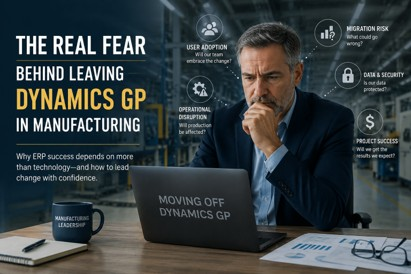
What’s Next: The Real Fear Behind Leaving Dynamics GP in Manufacturing
In this article, we’ve explored one of the most overlooked challenges in ERP modernization: the hidden complexity surrounding Dynamics GP. We discussed how customizations, GP ISV solutions, integrations, and ERP technical debt can become significant migration roadblocks when manufacturers don’t fully understand the dependencies supporting their operations. We also examined why modernization should focus on optimization rather than simply recreating the past.
But technical complexity is only part of the story.
Even when manufacturers understand their customizations, integrations, and migration requirements, many organizations still hesitate to move forward.
Why?
Because the biggest challenge is often not technical.
It’s human.
In the next article, “The Real Fear Behind Leaving Dynamics GP in Manufacturing,” we’ll explore the organizational and leadership concerns that frequently delay ERP modernization initiatives, including:
- What manufacturers are actually afraid of when leaving Dynamics GP
- Why operations teams often resist ERP projects
- How leaders can reduce ERP migration risk
- The role of ERP change management in successful implementations
- How manufacturers can improve ERP user adoption and business readiness
We’ll also discuss why many modernization projects struggle not because of technology limitations, but because organizations underestimate the importance of communication, training, stakeholder engagement, and change management.
Read Next: The Real Fear Behind Leaving Dynamics GP in Manufacturing: Why ERP Success Depends on More Than Technology
This next article shifts the conversation from technical readiness to organizational readiness, helping manufacturing leaders understand how to navigate the people side of ERP modernization with confidence.
Frequently Asked Questions
Why do Dynamics GP customizations become ERP migration roadblocks?
Dynamics GP customizations become migration roadblocks when organizations no longer understand how many business processes depend on them. The challenge is often determining what operational impact occurs if the customization is modified, replaced, or removed.
What Should Manufacturers Assess Before Migrating from Dynamics GP?
Manufacturers should assess their Dynamics GP customizations, GP ISV solutions, integrations, business processes, data quality, and ERP technical debt before migration. Understanding these dependencies helps reduce risk, control costs, and build a more effective ERP modernization strategy.
What happens to GP ISV solutions when moving to Business Central?
Some GP ISV solutions have Business Central equivalents, while others may be replaced by native functionality or alternative applications. Each ISV should be evaluated individually as part of the migration planning process.
Why are ISV dependencies a risk during ERP modernization?
ISV dependencies can increase migration complexity because they often support critical operational processes. Organizations need to understand whether those solutions can be migrated, replaced, or retired before modernization begins.
How do Dynamics GP integrations affect migration projects?
Integrations frequently connect ERP systems to manufacturing, warehouse, quality, and customer-facing applications. Undocumented or poorly understood integrations can significantly increase migration risk and project timelines.
What is ERP technical debt?
ERP technical debt is the accumulated complexity created by customizations, integrations, manual workarounds, spreadsheets, and legacy technologies that increase maintenance costs and modernization risk.
Should manufacturers recreate every customization in Business Central?
No. ERP modernization should include evaluating whether existing customizations still support business objectives and whether standard Business Central functionality can provide a simpler alternative.
What is the first step in an ERP modernization strategy?
The first step is understanding your current environment, including customizations, ISV dependencies, integrations, manual processes, and technical debt. Without that visibility, modernization planning becomes much more difficult.
Can Business Central Replace Most Dynamics GP ISV Solutions?
In many cases, yes. Business Central now includes functionality that often reduces or eliminates the need for some GP ISV solutions. However, each ISV should be evaluated individually to determine whether standard Business Central capabilities, a Business Central-compatible solution, or a different approach can replace it.
How Do I Know Which Dynamics GP Customizations Are Still Needed?
Start by identifying the business process each customization supports and the impact of removing it. Ask whether the customization still delivers value, creates a competitive advantage, or addresses a requirement that Business Central cannot handle natively. Many manufacturers discover that some customizations are no longer necessary and can be retired during modernization.
About Andrew Good

Andrew Good, CEO, Liberty Grove Software
Andrew Good, CEO of Liberty Grove Software, a leader in digital transformation, directs the company with strategic insights that deliver impactful results. With over two decades of expertise in Microsoft technologies, Andrew has guided businesses through digital transformation across manufacturing, finance, and healthcare.
Andrew’s extensive knowledge comes from personal experiences with various companies. His hands-on operational knowledge comes from Engineering, Maintenance, and operational roles at Unilever and Sony Music. Fourteen years of working with Microsoft Dynamics BC/NAV follows successful projects in ERP, Computerized Maintenance Management Systems (EAM), and quality systems.
His passion for technology is matched by his love for sailing, which inspires his leadership. Andrew parallels the precision of navigating the seas and the challenges of steering a successful company. Under his leadership, Liberty Grove Software thrives, offering tailored solutions to empower clients and optimize operations with innovative Microsoft-based systems.