Introduction
For many manufacturers evaluating a move from Microsoft Dynamics GP to Microsoft Dynamics 365 Business Central, the first questions usually focus on production.
Can Business Central support our manufacturing processes?
Will it handle our production orders?
Can it manage planning, scheduling, inventory, and purchasing?
Those are all important questions.
But after years of helping manufacturers modernize their ERP environments, I’ve found that one conversation inevitably rises to the top once executive teams move beyond functionality.
Can we trust the numbers?
For a CFO, manufacturing cost accounting isn’t simply an accounting exercise.
It influences pricing decisions.
It affects profitability.
It determines inventory valuation.
It impacts financial reporting.
And perhaps most importantly, it gives executives confidence that the information guiding business decisions accurately reflects what’s happening on the shop floor.
That is why Business Central manufacturing costing deserves far more attention during ERP modernization than many organizations initially realize.
The encouraging news is that Business Central provides manufacturers with a modern and highly capable manufacturing costing framework.
The challenge isn’t whether Business Central can calculate manufacturing costs.
The challenge is ensuring the organization’s costing methods, Bills of Material, routings, inventory practices, and financial assumptions are ready for a modern ERP platform.
“Manufacturing leaders don’t make decisions based on transactions. They make decisions based on confidence in the numbers. ERP modernization is an opportunity to improve that confidence, not simply recreate yesterday’s accounting processes.” – Andrew Good, CEO, Liberty Grove Software
That distinction is important.
Because the goal of modernization isn’t simply to replace Dynamics GP.
It’s to build a financial foundation that better supports growth, operational visibility, and executive decision-making.
Table of Contents
Why Manufacturing Cost Accounting Deserves Executive Attention
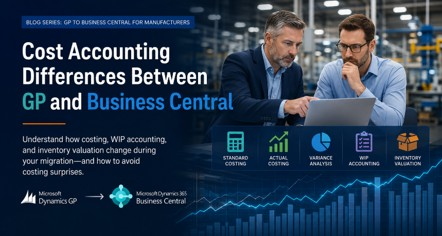
How Does Costing Differ Between Dynamics GP and Business Central?
Standard Costing vs Actual Costing: Understanding the Business Impact
What Happens to WIP and Manufacturing Inventory Valuation During Migration?
How Business Central Handles Manufacturing Variances
What CFOs Should Evaluate Before Migrating
A Story I See Repeatedly
How Manufacturers Can Avoid Costing Surprises During Implementation
Five Questions Every Executive Team Should Ask Before Migration
A Final Thought
Ready to Evaluate Your Manufacturing Costing Strategy?
What’s Next in This Series?
Frequently Asked Questions
Why Manufacturing Cost Accounting Deserves Executive Attention
Manufacturing costing influences far more than month-end financial reporting. Accurate cost data gives executives confidence in pricing, profitability, inventory valuation, production planning, and long-term strategic decisions.
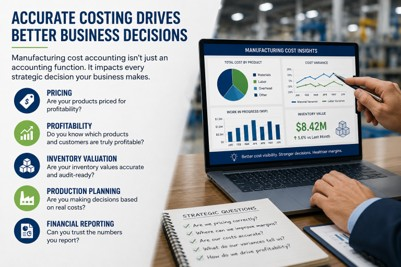
Cost accounting touches nearly every operational and financial decision a manufacturer makes.
Executives often think of costing as something finance owns.
In reality, manufacturing costing influences:
- Product pricing
- Gross margin analysis
- Inventory valuation
- Production planning
- Capacity decisions
- Financial reporting
- Customer profitability
- Executive forecasting
When costing information is inaccurate, every downstream decision becomes more difficult.
Organizations such as the Association for Supply Chain Management (ASCM) emphasize that accurate cost and inventory information is essential for improving operational performance, planning, and supply chain decision-making.
I’ve worked with manufacturers that believed they had a production scheduling problem.
Others assumed inventory accuracy was the issue.
In several cases, neither was true.
The underlying problem was inconsistent costing data that had accumulated over years of process changes, manual adjustments, and evolving business practices.
Once those issues were addressed, the operational challenges became much easier to solve.
That’s why I encourage executive teams to think about ERP modernization as an opportunity to strengthen financial visibility, not simply migrate accounting data.
How Does Costing Differ Between Dynamics GP and Business Central?
This is one of the first questions CFOs ask.
The answer is more nuanced than many expect.
Both Dynamics GP and Business Central support manufacturing costing, but they approach costing from different perspectives.
Dynamics GP has served manufacturers well for many years, particularly organizations with mature costing models that have evolved alongside their business.
Business Central builds on that foundation while providing a more integrated approach to manufacturing, inventory, production, and financial management.
Microsoft provides detailed information on Business Central’s manufacturing capabilities, including production management, planning, inventory, and costing functionality that supports modern manufacturing operations.
Rather than viewing costing as an isolated accounting function, Business Central connects manufacturing transactions directly to operational activities across purchasing, production, inventory, and finance.
That integration gives executives greater visibility into how operational decisions influence financial performance.
However, it also means manufacturers should carefully evaluate existing costing practices before migration.
“One of the biggest mistakes I see is assuming costing will work the same way simply because the products are the same. Modern ERP platforms often require organizations to rethink processes before they replicate them.” – Andrew Good
The objective should never be to recreate historical complexity.
The objective should be to improve financial visibility while supporting future growth.
Standard Costing vs Actual Costing: Understanding the Business Impact
One discussion that often surprises executive teams is the difference between standard costing and actual costing.
Both approaches have value.
Both can support successful manufacturing organizations.
The important question is which method best supports your business model and management objectives.
Standard costing provides consistency.
Organizations establish expected material, labor, and overhead costs, then measure manufacturing performance using production variances.
This approach simplifies budgeting, forecasting, and financial analysis while making operational performance easier to evaluate over time.
Actual costing, on the other hand, reflects the true cost of materials, labor, subcontracting, and overhead as production occurs.
For manufacturers experiencing significant fluctuations in material costs or production environments, actual costing may provide greater operational insight.
Microsoft explains the different costing methods available in Business Central and how each affects inventory valuation, cost flow, and financial reporting, helping manufacturers align ERP configuration with their business objectives.
Neither approach is universally better.
The right choice depends on factors such as:
- Product mix
- Production complexity
- Material price volatility
- Financial reporting requirements
- Management objectives
The key is understanding how your existing Dynamics GP costing model aligns with Business Central’s capabilities before implementation begins.
What Happens to WIP and Manufacturing Inventory Valuation During Migration?
One of the biggest concerns I hear from CFOs is straightforward.
“What happens to our inventory valuation during migration?”
It’s a fair question.
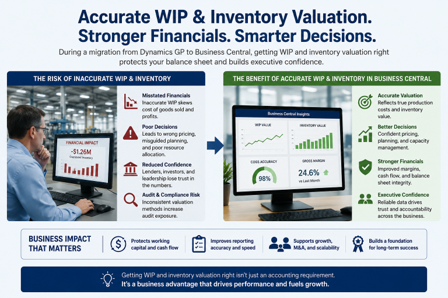
Work-in-progress inventory often represents one of the largest assets on a manufacturer’s balance sheet.
If executives lose confidence in WIP accounting or inventory valuation during an ERP implementation, confidence in the entire project can suffer.
Fortunately, Business Central provides strong capabilities for managing manufacturing inventory valuation and WIP accounting.
The challenge isn’t the software.
The challenge is ensuring that the underlying manufacturing data accurately reflects how the business operates.
Bills of Material.
Production routings.
Overhead calculations.
Labor assumptions.
Inventory transactions.
These all influence costing accuracy.
I’ve seen organizations spend weeks debating ERP configuration when the real issue was outdated production routings that no longer reflected actual manufacturing practices.
Once those routings were corrected, costing accuracy improved dramatically.
That experience reinforced something I’ve learned repeatedly.
ERP systems don’t create accurate costs.
Well-designed manufacturing processes do.
How Business Central Handles Manufacturing Variances
Manufacturing variances tell an important story.
They highlight differences between expected performance and actual operational results.
Business Central allows manufacturers to analyze a range of production variances, helping finance and operations teams identify opportunities for continuous improvement rather than simply explaining month-end results.
These insights may include:
- Material usage variances
- Capacity variances
- Labor variances
- Overhead variances
- Production efficiency variances
The goal is not merely to close the books.
The goal is to understand why performance differed from expectations and use that information to improve future operations.
Manufacturers that embrace variance analysis as a management tool often gain far more value from their ERP investment than organizations that treat it solely as an accounting requirement.
What CFOs Should Evaluate Before Migrating
Successful ERP modernization begins long before software implementation.
I’ve found that finance leaders who ask the right questions early experience far fewer surprises later.
Before migrating from Dynamics GP, I recommend evaluating:
- Current costing methodology
- Bills of Material accuracy
- Production routings
- Overhead allocation methods
- Inventory valuation processes
- WIP accounting practices
- Financial reporting requirements
- Historical manual adjustments
- Spreadsheet dependencies
- Audit and compliance requirements
One CFO I worked with initially believed the migration project would focus primarily on technology.
As we worked through costing workshops, it became clear that years of spreadsheet adjustments had gradually become part of the organization’s month-end close process.
Those spreadsheets weren’t solving ERP limitations.
They were compensating for outdated manufacturing data.
Once the organization corrected the underlying processes, month-end close became faster, reporting became more consistent, and executives spent less time debating numbers and more time discussing strategy.
“ERP modernization should improve financial confidence. If leadership finishes an implementation with the same questions they had before, we’ve missed an opportunity.” – Andrew Good
A Story I See Repeatedly
One experience stands out because it changed the way a leadership team viewed ERP modernization.
A mid-sized manufacturer had postponed moving from Dynamics GP for several years because the executive team was concerned that changing ERP systems would disrupt inventory valuation and manufacturing reporting. Their finance department had spent years refining reports, month-end procedures, and costing adjustments. From their perspective, the current system was working well enough.
As we began documenting their manufacturing costing processes, an unexpected issue emerged.
The biggest source of inconsistency wasn’t Dynamics GP.
It was the collection of manual processes that had gradually become part of their monthly close.
Different plants calculated overhead differently.
Engineering updates to Bills of Material weren’t always reflected in production routings.
Inventory adjustments were often made outside established procedures.
The ERP system wasn’t producing inaccurate information.
It was faithfully reflecting inconsistent business processes.
Once leadership recognized that, the conversation changed completely.
Instead of asking how to preserve every existing costing practice, they began asking how Business Central could help standardize them.
The implementation became more than an ERP project.
It became an opportunity to strengthen financial governance across the organization.
Several months after go-live, the CFO shared something that has stayed with me.
“For the first time, we’re spending our executive meetings discussing profitability instead of debating whether the numbers are accurate.”
That is the real value of ERP modernization: improving the quality of business decisions.
It isn’t simply replacing software.
It’s increasing confidence in the information leaders use to run the business.
How Manufacturers Can Avoid Costing Surprises During Implementation
One of the biggest misconceptions about ERP modernization is that costing decisions are made during software configuration.
In reality, the most successful projects begin long before implementation starts.
They begin with preparation.
Manufacturers that experience the smoothest transitions typically invest significant time understanding their current costing environment before making configuration decisions.
That preparation often includes:
- Reviewing Bills of Material for accuracy
- Validating production routings
- Evaluating overhead allocation methods
- Identifying spreadsheet-based calculations
- Documenting inventory valuation practices
- Confirming WIP accounting procedures
- Reviewing variance reporting requirements
- Aligning finance and operations around common costing objectives
Notice that very little on this list relates to technology.
Most of it relates to understanding how the business actually operates.
“Successful ERP implementations don’t begin with software. They begin with clarity. The more manufacturers understand their costing processes before implementation, the more confident they’ll be in the results after go-live.” – Andrew Good
Five Questions Every Executive Team Should Ask Before Migration
Before committing to a Dynamics GP migration strategy, I encourage executive teams to answer five important questions.
Do we fully understand how our current manufacturing costs are calculated?
Many organizations rely on costing rules that have evolved over many years.
Documenting those assumptions is an essential first step.
Are our Bills of Material and production routings still accurate?
ERP modernization often exposes inconsistencies that have accumulated gradually over time.
Correcting those issues before migration reduces implementation risk and improves long-term reporting.
Which manual processes have become part of month-end close?
Spreadsheets and manual adjustments frequently compensate for outdated processes rather than ERP limitations.
Understanding those dependencies creates opportunities for simplification.
Does our current costing model support where the business is going?
Growth through acquisitions, product expansion, new facilities, or increased automation may require a different level of financial visibility than today’s environment provides.
5. Are we treating migration as a technology project or a business improvement initiative?
This may be the most important question of all.
The manufacturers that achieve the greatest return from ERP modernization are the ones that treat implementation as a business improvement initiative, not simply a software replacement.
A Final Thought
Manufacturing cost accounting is about far more than calculating inventory values or closing the books each month.
It provides the financial foundation for pricing decisions.
It supports operational planning.
It influences profitability analysis.
It gives executives confidence that strategic decisions are based on accurate information.
After working with manufacturers for more than two decades, I’ve become convinced that the most successful ERP modernization projects share one characteristic.
They don’t focus exclusively on technology.
They focus on improving the business.
The National Association of Manufacturers (NAM) continues to highlight digital transformation, operational resilience, and data-driven decision-making as critical priorities for manufacturers seeking long-term competitiveness.
Business Central gives manufacturers an opportunity to modernize costing practices, strengthen financial visibility, simplify reporting, and create greater confidence across finance and operations.
That opportunity should never be wasted by simply recreating yesterday’s processes.
“ERP modernization isn’t about proving that your old system was wrong. It’s about preparing your business for what’s next. When manufacturers improve the quality of their costing information, they improve the quality of every decision that follows.” – Andrew Good
Ready to Strengthen Your Manufacturing Costing Strategy?
Before migrating from Dynamics GP to Business Central, manufacturers should understand how their current costing model supports the business today and whether it will support the business tomorrow.
Liberty Grove Software works with manufacturers to evaluate manufacturing costing, WIP accounting, inventory valuation, production reporting, and financial processes before implementation begins.
Our team helps organizations identify potential costing risks, validate manufacturing data, and develop ERP modernization strategies that improve financial visibility while reducing implementation risk.
Whether you’re evaluating standard costing, actual costing, manufacturing inventory valuation, or Business Central manufacturing costing capabilities, we’ll help you build a roadmap that aligns technology with your long-term business objectives.
Schedule a Manufacturing ERP Costing Assessment with Liberty Grove Software and see how a well-planned migration can strengthen financial confidence across your organization.
What’s Next in This Series?
Throughout this series, we’ve explored the most important questions manufacturers face when evaluating a move from Dynamics GP to Business Central.
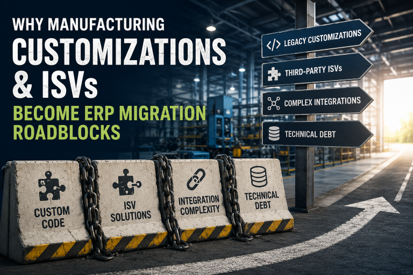
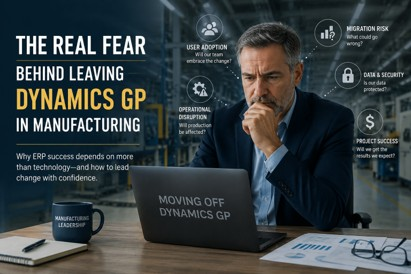
We’ve discussed Microsoft’s product roadmap, manufacturing functionality, organizational readiness, ERP change management, customizations, ISV dependencies, technical debt, and now the financial implications of manufacturing costing.
Together, these topics reinforce one important message:
Successful ERP modernization is not about replacing software. It’s about improving the business.
In our final article, we’ll examine one of the most common questions manufacturers ask when considering their long-term ERP strategy:
Should we host Dynamics GP in the cloud, or is it time to move to Business Central?
We’ll explore:
- The advantages and limitations of Hosted GP
- Why cloud hosting is not the same as ERP modernization
- When Hosted GP makes strategic sense
- When Business Central becomes the better long-term investment
- How manufacturers should evaluate cloud ERP strategies based on growth, scalability, and operational objectives
We’ll also help manufacturing leaders distinguish between extending the life of an existing ERP system and preparing the organization for the future.
Read Next
Hosted GP vs. Business Central: What Manufacturers Need to Consider
The final article in this series will help executives evaluate whether hosting Dynamics GP is a practical interim solution or whether Business Central is the stronger long-term strategy for improving modernization, scalability, and competitive advantage.
Frequently Asked Questions
How does Business Central handle manufacturing costing?
Business Central provides integrated manufacturing costing capabilities that connect production, inventory, purchasing, and finance. It supports standard costing, actual costing, manufacturing variances, WIP accounting, and inventory valuation, giving manufacturers greater visibility into production costs and financial performance.
How does costing differ between Dynamics GP and Business Central?
Both platforms support manufacturing costing, but Business Central offers a more integrated approach that connects operational transactions with financial reporting. Many manufacturers also benefit from improved visibility into production variances, inventory movements, and manufacturing performance.
What happens to WIP and inventory valuation during migration?
WIP accounting and inventory valuation do not simply transfer automatically. Manufacturers should validate Bills of Material, production routings, inventory transactions, and costing methods before migration to ensure accurate financial reporting after go-live.
How are manufacturing variances handled in Business Central?
Business Central captures and reports manufacturing variances related to materials, labor, overhead, capacity, and production efficiency. These insights help finance and operations teams identify opportunities to improve profitability and operational performance.
What should CFOs evaluate before migrating from Dynamics GP?
CFOs should review costing methodologies, inventory valuation practices, WIP accounting, Bills of Material, production routings, overhead allocation, reporting requirements, manual adjustments, spreadsheet dependencies, and audit considerations before implementation begins.
How can manufacturers avoid costing surprises during implementation?
The most successful manufacturers begin by documenting current costing processes, validating manufacturing master data, aligning finance and operations, and correcting inconsistencies before ERP configuration starts. Preparation significantly reduces implementation risk.
Is Business Central better than Dynamics GP for manufacturing costing?
For many manufacturers, Business Central provides stronger integration between manufacturing operations and financial reporting. However, the greatest benefits are achieved when organizations use the migration as an opportunity to modernize costing practices rather than simply replicate legacy processes.
Can manufacturers continue using standard costing in Business Central?
Yes. Business Central supports standard costing as well as other costing methods. The appropriate approach depends on your manufacturing environment, financial reporting requirements, and management objectives.
Why is manufacturing cost accounting important during ERP modernization?
Manufacturing costing affects inventory valuation, profitability, pricing, production planning, financial reporting, and executive decision-making. Evaluating costing processes before migration helps ensure that ERP modernization strengthens both operational performance and financial confidence.
About Andrew Good

Andrew Good, CEO, Liberty Grove Software
Andrew Good, CEO of Liberty Grove Software, a leader in digital transformation, directs the company with strategic insights that deliver impactful results. With over two decades of expertise in Microsoft technologies, Andrew has guided businesses through digital transformation across manufacturing, finance, and healthcare.
Andrew’s extensive knowledge comes from personal experiences with various companies. His hands-on operational knowledge comes from Engineering, Maintenance, and operational roles at Unilever and Sony Music. Fourteen years of working with Microsoft Dynamics BC/NAV follows successful projects in ERP, Computerized Maintenance Management Systems (EAM), and quality systems.
His passion for technology is matched by his love for sailing, which inspires his leadership. Andrew parallels the precision of navigating the seas and the challenges of steering a successful company. Under his leadership, Liberty Grove Software thrives, offering tailored solutions to empower clients and optimize operations with innovative Microsoft-based systems.