In my experience, this question is rarely about functionality.
It is usually about confidence.
Manufacturing leaders want to know whether Business Central can support the realities of their operation: production schedules that cannot slip, inventory that must be accurate, customer commitments that must be met, and teams that depend on reliable information every day.
The concern isn’t whether Business Central has manufacturing features. The concern is whether those features can support the business when complexity increases.
In the first article, “Why Manufacturers Using Dynamics GP Are Hesitant to Move to Business Central,” we explored why manufacturers tend to approach ERP modernization differently from other Dynamics GP customers.
The conversation was never really about Microsoft Dynamics GP.
It was about risk.
Manufacturing executives rely on ERP systems to orchestrate production, inventory, scheduling, procurement, cost control, quality assurance, and fulfillment of customer commitments. Given this centrality to daily operations, any platform change is a strategic move.
That is why one question comes up in almost every manufacturing ERP assessment:
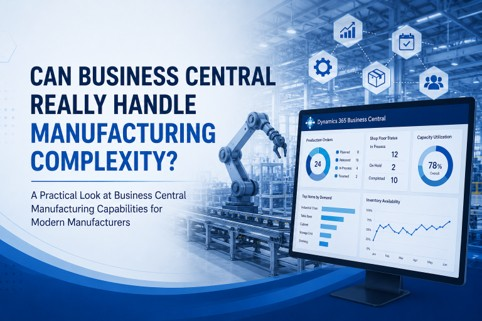
Can Business Central really handle manufacturing complexity?
Most manufacturers are not simply asking about Business Central’s manufacturing functionality.
They have a more important concern.
Can it support how we operate today and where we need to go tomorrow?
Can it enable our targeted growth and evolving strategies?
One operations leader recently told us:
“We’re not worried about replacing GP. We’re worried about replacing everything we’ve built around GP.”
That concern is understandable.
Many manufacturers have spent years building processes, customizations, reports, integrations, and workarounds around Dynamics GP. The ERP system is only part of what is being evaluated.
The good news is that many perceptions about Business Central’s manufacturing capabilities are based on outdated information.
Microsoft has invested heavily in Business Central manufacturing functionality, and the platform has evolved significantly over the last several years.
Before making a decision, executives should understand Business Central’s capabilities within a broader, long-term manufacturing technology strategy.
What We See Most Often
Most manufacturers do not begin ERP evaluations by asking whether Business Central can create a production order.
They begin by asking whether it can support the operational complexity they have accumulated over years of growth.
We frequently hear concerns about:
- multi-site production
- custom scheduling processes
- production costing
- quality management
- warehouse operations
- engineer-to-order requirements
In many cases, the concern is not that Business Central lacks functionality. It is uncertainty about how current processes will translate into a modern ERP environment.
One manufacturer we worked with was particularly concerned about production costing. Over the years, the company had built custom reports, spreadsheets, and review processes around Dynamics GP to analyze product profitability and monitor cost variances across multiple product lines.
Their leadership team initially assumed those processes would be difficult to replicate in Business Central. However, after evaluating the requirements more closely, they discovered that much of the complexity was not tied to the ERP platform itself. It was tied to reporting practices and manual processes that had evolved over time.
That realization shifted the conversation from “Can Business Central handle our costing requirements?” to “Which parts of our costing process actually create value today?”
Table of Contents
What We See Most Often
Four Questions Every Manufacturer Should Ask Before Evaluating Business Central
Can Business Central Support Make-to-Stock, Make-to-Order, and Engineer-to-Order Manufacturing?
How Does Business Central Handle Production Orders and Routings?
Can Business Central Provide Shop Floor Visibility?
What Manufacturing Functionality Is Native Versus Requiring ISVs?
Is Business Central Robust Enough for Complex Manufacturing Operations?
Why Manufacturers Should Stop Comparing Business Central to GP Feature-by-Feature
What Manufacturers Should Do Next
The Bottom Line
Frequently Asked Questions
Four Questions Every Manufacturer Should Ask Before Evaluating Business Central
The Wrong Question
Many manufacturers ask:
“Can Business Central do what GP does?”
A better question is:
“Can Business Central support where the business needs to go next?”
The most successful ERP modernization projects focus less on replicating existing processes and more on creating a platform that supports future growth.
When evaluating Business Central, executive discussions should start with strategic business objectives rather than features.
It should begin with a strategy.
Leadership teams should examine four essential questions before focusing on software capabilities.
1. Are We Solving for Today’s Processes or Tomorrow’s Growth?
Many ERP evaluations focus on recreating current workflows.
The more powerful consideration is whether those workflows will support the business’s strategic direction over the next five years.
2. Which Manufacturing Capabilities Truly Differentiate Our Business?
Not every customization creates value.
Some drive competitive advantage.
Others simply preserve historical habits.
Many manufacturers assume every customization is mission-critical. During assessments, we often discover that only a small percentage of custom processes actually create competitive advantage.
The goal is to separate what truly differentiates the business from what has simply become familiar over time.
3. Which Customizations Have Become Technical Debt?
Many manufacturers discover that years of modifications have created complexity that slows innovation rather than enabling it.
Over the years, many ERP environments accumulate reports, integrations, spreadsheets, and custom workflows that were created to solve legitimate business problems.
The challenge is determining which of those solutions still provide value and which now create unnecessary complexity. What once improved efficiency can eventually make modernization more difficult and expensive.
4. What Is the Cost of Waiting?
The risk is rarely that Dynamics GP suddenly stops working.
The greater executive risk lies in postponing modernization until operational bottlenecks translate into business constraints.
These questions guide executive decision-making more effectively than a functionality checklist.
Most organizations evaluate the cost of modernization. Far fewer evaluate the cost of waiting. Delaying decisions can mean continuing to invest in aging customizations, manual workarounds, and increasingly complex support requirements.
The earlier organizations begin planning, the more options they typically have available.
Can Business Central Support Make-to-Stock, Make-to-Order, and Engineer-to-Order Manufacturing?
One of the most common misconceptions we encounter is that Business Central only supports simple manufacturing environments.
The reality is far different.
Business Central supports multiple manufacturing models, including make-to-stock, make-to-order, and many engineer-to-order environments.
Make-to-Stock Manufacturing
Manufacturers operating a make-to-stock model rely on forecasting, inventory optimization, and production planning to meet customer demand.
- Demand forecasting
- Inventory replenishment planning
- Production scheduling
- Material requirements planning
- Capacity management
- Supply chain visibility
These capabilities help manufacturers balance inventory investment with customer service requirements.
Make-to-Order Manufacturing
A make-to-order environment requires close alignment between customer demand and production activity.
Business Central supports:
- Sales-order-driven production
- Demand linking
- Material allocation
- Production scheduling
- Order tracking
This enables manufacturers to maintain visibility into customer-specific production while managing inventory and capacity constraints.
Engineer-to-Order Manufacturing
Engineer-to-order environments often represent the highest level of manufacturing complexity.
Business Central can support many engineer-to-order requirements, particularly when paired with complementary engineering, configuration, or product lifecycle management solutions.
The key takeaway is straightforward.
Business Central supports multiple manufacturing models.
The more strategic question is whether it aligns with your operating model and vision.
During one assessment, a manufacturer assumed Business Central would struggle with its engineer-to-order environment because of the number of custom processes involved.
After mapping the workflows, we discovered that most of the complexity was not in the ERP system itself. It existed in approvals, spreadsheets, reporting processes, and engineering handoffs that had evolved around the ERP over time.
Once the team separated true ERP requirements from historical workarounds, the Business Central evaluation became much more straightforward.
How Does Business Central Handle Production Orders and Routings?
Production management sits at the core of every manufacturing ERP platform.
Without strong production controls, manufacturers struggle to maintain efficiency, visibility, and profitability.
Business Central provides native support for:
- Planned production orders
- Firm planned production orders
- Released production orders
- Finished production orders
- Work centers
- Machine centers
- Routing management
- Capacity planning
Manufacturers can build routings that reflect real-world production processes while tracking labor, machine time, and operational progress.
For many organizations moving from Dynamics GP, these capabilities exceed expectations.
One plant manager recently summarized the issue this way:
“I don’t need another report. I need to know what’s happening on the floor before the shift ends.”
That expectation is becoming increasingly common across manufacturing organizations.
Can Business Central Provide Shop Floor Visibility?
Manufacturing leaders want more than historical reporting.
They want operational visibility while decisions can still influence outcomes.
Business Central provides access to:
- Production status
- Inventory availability
- Material consumption
- Capacity utilization
- Work center performance
- Order progress
However, Business Central is not a manufacturing execution system.
One misconception is that ERP systems should perform every manufacturing function.
Modern manufacturing technology strategies increasingly rely on connected platforms. ERP, MES, quality systems, warehouse systems, and analytics tools each play distinct roles.
The goal is not to force Business Central to become everything. The goal is to ensure it serves as the operational and financial foundation connecting those systems.
Organizations requiring advanced machine monitoring, automated data collection, barcode-driven reporting, or detailed production execution often supplement Business Central with MES solutions.
This is not a weakness.
It reflects a modern technology strategy.
Business Central serves as the operational and financial foundation, while specialized solutions extend functionality where necessary.
What Manufacturing Functionality Is Native Versus Requiring ISVs?
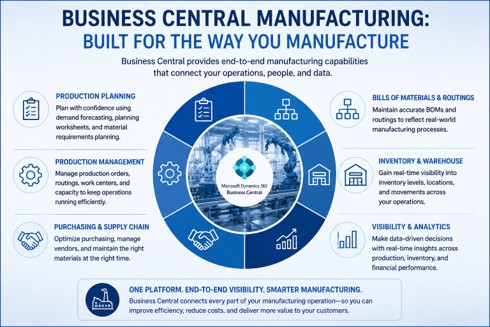
One of the most important ERP evaluation questions is understanding what is included natively and what may require third-party solutions.
Native Business Central Manufacturing Features
Business Central includes:
- Bills of materials
- Routings
- Production orders
- Inventory management
- Warehouse management
- Planning worksheets
- Capacity planning
- Demand forecasting
- Supply planning
- Standard costing
For many manufacturers, these capabilities satisfy most operational requirements.
Where ISVs Extend Functionality
Independent software vendors commonly enhance Business Central in areas such as:
- Advanced planning and scheduling
- Quality management
- Product configuration
- Manufacturing execution
- Compliance management
- Warehouse automation
This flexibility allows manufacturers to create a solution ecosystem aligned to their specific needs.
Manufacturers can also leverage Microsoft’s AppSource ecosystem to extend Business Central with industry-specific manufacturing capabilities when required.
Is Business Central Robust Enough for Complex Manufacturing Operations?
The answer depends on how complexity is defined.
Complex manufacturing environments may include:
- Multiple facilities
- International operations
- Engineer-to-order workflows
- Highly regulated industries
- Large product catalogs
- Complex supply chains
- Automation initiatives
Business Central successfully supports manufacturers operating in each of these environments today.
Success is determined by strategy and leadership, not just software capabilities.
Implementation strategy matters.
Business process design matters.
Organizational readiness matters.
Manufacturers that view ERP modernization as a business transformation initiative often achieve stronger outcomes than those treating it as a software replacement project.
Why Manufacturers Should Stop Comparing Business Central to GP Feature-by-Feature
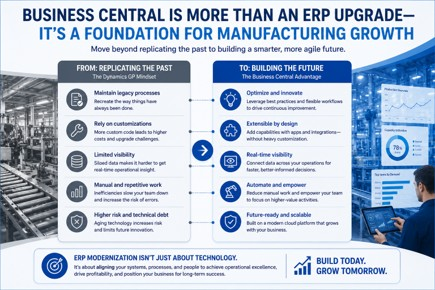
This is one of the most important lessons manufacturers learn during ERP evaluations.
Many organizations begin by comparing every screen, report, customization, and workflow between GP and Business Central.
At first, this feels logical.
In practice, it often creates unnecessary limitations.
Feature comparisons feel objective because they can be measured.
Unfortunately, they often focus attention on the past rather than the future.
The manufacturers that achieve the best outcomes rarely ask whether every screen looks the same. They ask whether the new platform enables better decisions, greater visibility, and stronger scalability.
One CFO recently told us:
“We’re spending too much time asking whether Business Central has the same features as GP and not enough time asking whether our current processes still make sense.”
That observation captures the challenge perfectly.
ERP modernization should not focus on rebuilding the past.
It should focus on building the future.
The manufacturers that gain the most value from Business Central are often the ones willing to challenge assumptions, simplify workflows, reduce customization debt, and embrace better ways of operating.
Business Central provides an opportunity to:
- Simplify workflows
- Reduce customization debt
- Improve visibility
- Increase automation
- Enhance reporting
- Improve decision-making
Modern capabilities such as AI-assisted workflows, automation, and cloud-based analytics are increasingly becoming part of manufacturing technology roadmaps.
The goal is not to recreate Dynamics GP in a new environment.
The goal is to create a more agile foundation for long-term growth.
What Manufacturers Should Do Next
If you’re evaluating Business Central, begin by documenting your manufacturing processes rather than your software requirements.
Identify which capabilities create competitive advantage, which customizations create complexity, and which operational challenges are limiting growth today.
The objective is not to determine whether Business Central can replicate the past.
The objective is to determine whether it can support the future.
The Bottom Line
Can Business Central handle manufacturing complexity?
For many manufacturers, yes.
Business Central supports make-to-stock, make-to-order, and many engineer-to-order environments. It provides production planning, inventory management, routing control, capacity management, and operational visibility while integrating effectively with specialized manufacturing technologies.
The better question is not whether Business Central can support manufacturing.
The better question is whether your organization is prepared to take advantage of what ERP modernization makes possible.
Manufacturers that approach Business Central strategically often discover the platform supports both current requirements and future growth.
Ready to Evaluate Business Central for Your Manufacturing Operation?
Every manufacturer is different.
The right ERP strategy depends on your operational complexity, growth objectives, production model, and long-term vision.
At Liberty Grove Software, we help manufacturers assess manufacturing ERP modernization capabilities against real-world business requirements so they can make informed decisions with confidence.
Schedule a Manufacturing ERP Assessment with Liberty Grove Software today and discover whether Business Central is the right platform to support your next stage of growth.
Coming Next in This Series: The Real Fear Behind Leaving Dynamics GP in Manufacturing
Technology is rarely the biggest obstacle to ERP modernization.
People are.
In the next article, we’ll explore what manufacturers are afraid of when considering a Dynamics GP migration. We’ll examine concerns about operational disruption, employee resistance, implementation risk, user adoption, and change management.
More importantly, we’ll discuss why some manufacturing ERP implementation projects succeed while others struggle, and what leaders can do to reduce risk before migration begins.
Frequently Asked Questions
Can Business Central handle manufacturing?
Yes. Business Central includes native manufacturing functionality for production orders, routings, bills of materials, inventory management, capacity planning, and forecasting.
Is Business Central good for manufacturing?
Business Central is a strong manufacturing ERP platform for many small- and mid-sized manufacturers, particularly when combined with industry-specific extensions as needed.
Can Business Central support make-to-order manufacturing?
Yes. Business Central supports make-to-order manufacturing through sales-order-driven production, demand linking, scheduling, and material planning.
Can Business Central integrate with MES systems?
Yes. Business Central integrates with many manufacturing execution systems to provide enhanced shop floor visibility and operational control.
What manufacturing functionality is native in Business Central?
Native capabilities include bills of materials, routings, production orders, planning worksheets, inventory management, warehouse management, forecasting, and capacity planning.
Is Business Central better than Dynamics GP?
Business Central offers modern cloud architecture, continuous innovation, enhanced Microsoft integration, and greater scalability. The right choice depends on your organization’s requirements and long-term strategy.
How difficult is a Dynamics GP migration?
Migration complexity varies based on customizations, integrations, data quality, manufacturing processes, and organizational readiness. Proper planning significantly reduces risk.
About Andrew Good

Andrew Good, CEO, Liberty Grove Software
Andrew Good, CEO of Liberty Grove Software, a leader in digital transformation, directs the company with strategic insights that deliver impactful results. With over two decades of expertise in Microsoft technologies, Andrew has guided businesses through digital transformation across manufacturing, finance, and healthcare.
Andrew’s extensive knowledge comes from personal experiences with various companies. His hands-on operational knowledge comes from Engineering, Maintenance, and operational roles at Unilever and Sony Music. Fourteen years of working with Microsoft Dynamics BC/NAV follows successful projects in ERP, Computerized Maintenance Management Systems (EAM), and quality systems.
His passion for technology is matched by his love for sailing, which inspires his leadership. Andrew parallels the precision of navigating the seas and the challenges of steering a successful company. Under his leadership, Liberty Grove Software thrives, offering tailored solutions to empower clients and optimize operations with innovative Microsoft-based systems.