The Real Fear Behind Leaving Dynamics GP in Manufacturing
For years, Dynamics GP has been a reliable platform for manufacturers.
It processes orders.
Supports production.
Manages inventory.
Runs financials.
Generates reports.
The business knows how it works.
The team knows where to find information.
Processes have been built around it.
People trust it.
Which is why so many manufacturers hesitate when the conversation turns to modernization.
At first glance, it appears to be a technology decision.
Should we move to Business Central?
Can the new Business Central platform support our manufacturing environment?
Will the functionality meet our requirements?
Those questions matter.
But after helping manufacturers evaluate and execute ERP modernization initiatives, I've learned that the biggest challenge is rarely the software itself.
The real challenge is uncertainty.
Manufacturers are not usually afraid of Business Central.
They are afraid of what might happen to the business during the transition.
Will operations be disrupted?
Will employees embrace the change?
Will production slow down?
Will critical data be lost?
Will customers feel the impact?
Will the project succeed?
Those concerns are understandable.
They are also exactly why successful ERP modernization requires more than technology planning.
It requires leadership, communication, and change management.
Microsoft's Dynamics 365 Business Central platform continues to evolve as the company's primary cloud ERP solution for small and midsized organizations.
As Andrew Good often says:
"Manufacturers rarely resist new technology. They resist unnecessary risk. The organizations that modernize successfully are the ones that reduce uncertainty before asking people to change."
That distinction is important.
Because the real fear behind leaving Dynamics GP is not the software.
It is the fear of disrupting the business.
Table of Contents
Why Manufacturers Hesitate to Leave Dynamics GP
What Are Manufacturers Actually Afraid of When Moving Off GP?
How Much Operational Disruption Should Manufacturers Expect?
Why ERP Projects Face Resistance From Operations Teams
The Hidden Cost of Waiting Too Long
How Manufacturers Can Reduce ERP Migration Risk
What Role Does Change Management Play in ERP Success?
A Story I See Repeatedly
Manufacturing Digital Transformation Is Ultimately About Confidence
A Final Thought
Ready to Reduce ERP Migration Risk?
Why Manufacturers Hesitate to Leave Dynamics GP
Executives often tell me the same thing.
"We know we need to modernize."
I've sat in dozens of executive planning sessions where leadership teams agree that modernization is necessary. The challenge isn't recognizing the need for change. The challenge is deciding when and how to make it happen without disrupting the business.
Yet months or even years pass before a decision is made.
Why?
Because Dynamics GP still works.
The business has adapted to it.
Processes have been built around it.
Employees understand it.
Leadership knows its limitations.
There is comfort in familiarity.
Even when executives recognize that modernization is necessary, familiarity often feels safer than change.
The challenge is that familiarity can create a false sense of security.
Many manufacturers assume that staying on a familiar platform reduces risk.
Manufacturers might also consider Microsoft's published Dynamics GP lifecycle roadmap when evaluating long-term modernization plans.
In reality, delaying modernization can introduce new risks:
- Increasing technical debt
- Rising support costs
- Aging integrations
- Cybersecurity concerns
- Limited scalability
- Reduced visibility
- Difficulty attracting modern ERP talent
The decision is not whether change will happen.
The decision is whether the organization will manage change proactively or react to it later.
As manufacturers evaluate aging technology environments, cybersecurity risk has become an increasingly important consideration for executive leadership teams.
What Are Manufacturers Actually Afraid of When Moving Off GP?
In my experience, manufacturers are not afraid of software.
They are afraid of consequences.
Specifically:
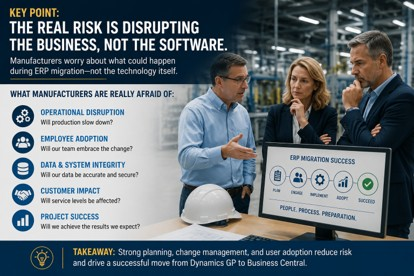
Production Disruption
Manufacturing leaders worry that implementation challenges will impact production schedules, customer commitments, and operational performance.
For manufacturers, concerns often center around production schedules, inventory accuracy, shipping commitments, quality processes, and customer service levels.
Employee Resistance
Managers know that change creates uncertainty.
If users struggle to adopt new processes, productivity may suffer.
Loss of Institutional Knowledge
Long-tenured employees often understand critical processes, reports, and workarounds.
Organizations fear losing that knowledge during modernization.
Project Failure
ERP implementations require investment.
Executives want confidence that the project will deliver business value.
Customer Impact
Manufacturers work hard to build trust with customers.
No leadership team wants ERP disruption to affect service levels or delivery performance.
Andrew often frames it this way:
"Most manufacturers are not worried about learning new software. They're worried about protecting the business while change is happening."
That is the real concern.
How Much Operational Disruption Should Manufacturers Expect?
This is one of the most common questions executives ask.
The answer surprises many leaders.
One of the biggest misconceptions I encounter is that ERP modernization automatically means months of operational disruption.
The manufacturers that experience the smoothest transitions are usually the organizations that spend the most time preparing before implementation begins.
Well-managed ERP modernization projects typically involve far less disruption than organizations expect.
The key phrase is well-managed.
Successful projects do not rely on luck.
They rely on planning.
Strong implementations include:
- Process documentation
- Data preparation
- User training
- Pilot testing
- Executive sponsorship
- Change management
- Clear communication
Organizations that invest in these activities generally experience smoother transitions than those focused exclusively on technical deployment.
The goal should not be avoiding disruption entirely.
The goal should be to manage disruption so the business continues to operate effectively throughout the transition.
Why ERP Projects Face Resistance From Operations Teams
Operations teams are measured on performance.
Production output.
Inventory accuracy.
Customer delivery.
Quality metrics.
Downtime.
Efficiency.
When ERP modernization is introduced, operations leaders often view it through a different lens than executives.
Executives see opportunity.
Operations teams see risk.
Both perspectives are valid.
One experience stands out from a manufacturing ERP assessment I led several years ago.
The executive team was eager to modernize and viewed the project as a necessary step toward growth and improved visibility.
However, the operations team was hesitant from the beginning. Leadership initially interpreted that hesitation as resistance to change.
What we eventually discovered was something very different.
The operations managers weren't resisting modernization; they were protecting production schedules, customer commitments, inventory accuracy, and delivery performance.
They understood exactly where disruptions could occur because they lived with those processes every day.
Once those leaders were brought into planning discussions, their concerns became valuable input rather than obstacles. In fact, several of the safeguards that ultimately contributed to a successful implementation came directly from the operations team.
I've seen this pattern repeated many times. The people who appear most resistant to ERP change are often the people who understand the business best.
One manufacturing executive shared a lesson that has stayed with me.
When leadership announced an ERP modernization initiative, operations managers immediately started listing potential problems.
Executives initially interpreted the reaction as resistance.
In reality, it was expertise.
The operations team understood exactly where disruptions could occur.
Once leadership involved operations teams early in planning, the conversation shifted from resistance to collaboration, significantly reducing risk and increasing the likelihood of project success.
The managers who initially seemed resistant became some of the strongest advocates for the project.
The lesson is simple.
People support what they help create.
ERP change management is not about convincing people to accept change.
It is about involving them early enough that they become part of the solution.
The Hidden Cost of Waiting Too Long
Many manufacturers believe delaying ERP modernization reduces risk.
Sometimes the opposite is true.
I have seen organizations postpone decisions for years because they were worried about implementation challenges.
During that time:
- Technical debt increased
- Integrations became harder to support
- Customizations became more complex
- Reporting challenges multiplied
- Talent gaps widened
Eventually, the business faced even greater modernization risk than it would have encountered years earlier.
Legacy ERP environments often create costs that are not immediately visible to leadership.
Support expenses increase, decision-making slows, and scalability becomes more difficult as technical debt accumulates.
Growth initiatives such as acquisitions, new facilities, product expansion, or operational automation can become harder to execute because systems and processes were never designed to support the next stage of the business.
What initially feels like a strategy for avoiding risk can ultimately become a barrier to profitability, agility, and long-term growth.
Andrew often tells clients:
"The cost of change is visible. The cost of delay is often hidden until it becomes impossible to ignore."
That is an important leadership consideration.
One manufacturer delayed modernization for three years because leadership was concerned about disruption. During that period, the company completed two acquisitions and struggled to integrate reporting, inventory visibility, and financial processes across locations. By the time modernization began, the project scope and cost had grown significantly beyond what would have been required earlier.
How Manufacturers Can Reduce ERP Migration Risk
Reducing ERP migration risk starts with preparation.
The strongest projects focus on business readiness as much as technical readiness.
Key areas include:
Executive Alignment
Leadership teams must agree on objectives, priorities, and expected outcomes.
Process Assessment
Document how work is performed today and identify opportunities for improvement.
Data Readiness
Clean, accurate data reduces implementation complexity.
User Engagement
Involve users early and often.
Training Programs
Invest in practical, role-based education.
Change Management
Build a structured plan to support adoption and communication.
Partner Selection
Work with implementation partners who understand manufacturing operations, not just software.
ERP migration risk is rarely reduced by technology alone.
It is reduced through preparation.
What Role Does Change Management Play in ERP Success?
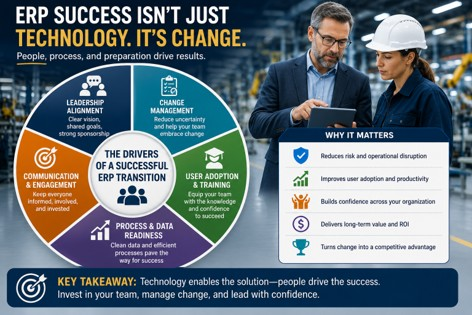
Change management is one of the most overlooked drivers of ERP success.
Research consistently shows that projects with strong change management practices are significantly more likely to achieve their objectives.
Many organizations treat ERP implementation as a technology project.
The most successful manufacturers treat it as a business transformation initiative.
Technology enables change.
People determine whether change succeeds.
Strong change management helps organizations:
- Build trust
- Reduce uncertainty
- Increase user adoption
- Improve communication
- Strengthen training outcomes
- Support leadership alignment
Without change management, even technically successful implementations can struggle.
With it, organizations are far more likely to realize the business benefits they expected.
Andrew summarizes it perfectly:
"ERP success isn't determined by go-live. It's determined by what happens after go-live. Adoption is where the real return on investment is created."
A Story I See Repeatedly
One manufacturer spent nearly two years debating whether to move forward with ERP modernization.
The leadership team worried about disruption.
Operations leadership worried about productivity.
Finance worried about risk.
Everyone agreed that change was necessary.
No one wanted to be responsible for making the decision.
Eventually, leadership conducted a formal ERP assessment.
What they discovered was surprising.
The greatest risk was not migration.
The greatest risk was standing still.
Aging technology, unsupported processes, growing technical debt, and increasing operational complexity posed a larger threat to the business than modernization itself.
Once leadership understood the actual risks, the conversation changed.
The project moved forward.
The focus shifted from fear to preparation.
That shift made all the difference.
Manufacturing Digital Transformation Is Ultimately About Confidence
Successful manufacturers do not modernize because technology changes.
One thing I've learned over the years is that the strongest modernization initiatives are rarely driven by technology alone.
They are driven by business leaders who recognize that future growth, visibility, scalability, and competitiveness require a different foundation than what worked ten years ago.
Manufacturers modernize because business requirements change.
Growth.
Visibility.
Scalability.
Customer expectations.
Workforce challenges.
Competitive pressure.
Digital transformation is not about replacing software.
It is about creating confidence in the future.
Confidence that systems can scale.
Confidence that teams can adapt.
Confidence that operations can support growth.
Confidence that leadership can make better decisions.
The manufacturers that succeed are not the ones that eliminate uncertainty.
They are the ones who manage it effectively.
Digital transformation initiatives are increasingly focused on creating organizational agility, operational visibility, and long-term scalability.
A Final Thought
The biggest challenge in Dynamics GP migrations is rarely technology.
It is fear.
Fear of disruption.
Fear of failure.
Fear of operational impact.
Fear of making the wrong decision.
Those concerns are understandable.
But they should not prevent manufacturers from evaluating what is best for the future business.
Modernization succeeds when organizations replace uncertainty with preparation, communication, and leadership.
As Andrew Good often reminds manufacturing executives:
"The goal is not to avoid change. The goal is to create enough clarity that change becomes manageable."
That is where successful ERP modernization begins.
Ready to Reduce ERP Migration Risk?
If your organization is evaluating a move from Dynamics GP to Microsoft Dynamics 365 Business Central, Liberty Grove Software can help.
We work with manufacturers to assess readiness, identify migration risks, support ERP change management, and develop modernization strategies aligned with long-term business objectives.
Before investing in migration planning, make sure you understand what your business truly depends on.
Schedule a Manufacturing ERP Assessment with Liberty Grove Software to better understand your current environment, future requirements, and the path forward.
What's Next in This Series?
In this article, we've explored one of the most overlooked challenges in ERP modernization: the human side of change.
We discussed why manufacturers often hesitate to leave Dynamics GP, the fears that drive resistance to modernization, and how leadership, communication, user adoption, and ERP change management play critical roles in reducing risk and improving project outcomes.
The key takeaway is simple:
Most ERP modernization challenges are not technology challenges. They are business challenges.
Successful manufacturers replace uncertainty with preparation, involve stakeholders early, and recognize that organizational readiness is just as important as technical readiness.
But once leadership teams understand the risks, align stakeholders, and build confidence in the future, another important question emerges:
What does a successful Dynamics GP to Business Central migration actually look like?
In the next article in this series, we'll explore:
- How manufacturers should prepare for a Dynamics GP migration
- Common mistakes that create unnecessary project risk
- What should happen before implementation begins
- How to evaluate data, processes, integrations, and reporting requirements
- Best practices for reducing disruption during ERP modernization
- What successful manufacturers do differently during migration planning
We'll also discuss how organizations can move beyond simply replacing software and use ERP modernization as an opportunity to improve processes, increase visibility, and create a stronger foundation for future growth.
Read Next:
From Planning to Execution: How Manufacturers Can Successfully Migrate from Dynamics GP to Business Central
This next article will focus on the practical side of ERP modernization, helping manufacturing leaders understand how to reduce risk, avoid common pitfalls, and build a migration strategy that supports long-term business success.
Frequently Asked Questions
What are manufacturers actually afraid of when moving off GP?
Most manufacturers are concerned about operational disruption, employee adoption, project risk, customer impact, and business continuity during ERP modernization.
How much operational disruption should manufacturers expect?
With proper planning, training, testing, and change management, operational disruption is often far less significant than organizations initially expect.
Why do ERP projects face resistance from operations teams?
Operations teams are responsible for daily performance. Resistance often reflects concern about business impact rather than opposition to modernization itself.
How can manufacturers reduce ERP migration risk?
Manufacturers can reduce risk through executive alignment, process assessment, data readiness, user engagement, training, structured change management, and experienced implementation partners.
What role does change management play in ERP success?
Change management helps improve communication, increase user adoption, reduce uncertainty, and support long-term business outcomes after go-live.
What are the risks of moving from Dynamics GP to Business Central?
Potential risks include operational disruption, user adoption challenges, data migration issues, and project delays. However, these risks can be significantly reduced through proper planning, stakeholder engagement, and change management.
About Andrew Good

Andrew Good, CEO, Liberty Grove Software
Andrew Good, CEO of Liberty Grove Software, a leader in digital transformation, directs the company with strategic insights that deliver impactful results. With over two decades of expertise in Microsoft technologies, Andrew has guided businesses through digital transformation across manufacturing, finance, and healthcare.
Andrew's extensive knowledge comes from personal experiences with various companies. His hands-on operational knowledge comes from Engineering, Maintenance, and operational roles at Unilever and Sony Music. Fourteen years of working with Microsoft Dynamics BC/NAV follows successful projects in ERP, Computerized Maintenance Management Systems (EAM), and quality systems.
His passion for technology is matched by his love for sailing, which inspires his leadership. Andrew parallels the precision of navigating the seas and the challenges of steering a successful company. Under his leadership, Liberty Grove Software thrives, offering tailored solutions to empower clients and optimize operations with innovative Microsoft-based systems.