How to Build a Business Case for Moving from Dynamics GP to Business Central
For most manufacturing executives, the hardest question about ERP modernization is not whether newer technology exists.
It is whether the investment can be justified.
A CFO sees implementation costs. A COO sees potential disruption. A CEO wants to understand how modernization supports growth. A board may reasonably ask why a system that still processes orders, closes the books, and produces financial statements needs to change at all.
Those are good questions.
I have spent enough time around manufacturing organizations to know that telling an executive team, “Your ERP is old,” is not a compelling business case.
Nor should it be.
Moving from Microsoft Dynamics GP to Microsoft Dynamics 365 Business Central should not be justified simply because Business Central is newer. The decision needs to connect technology investment to measurable business outcomes, operational risk, future capability, and the organization’s strategic direction.
In the previous article in this series, “What Data Should Manufacturers Migrate from Dynamics GP to Business Central?”, I made a similar argument about data: don’t migrate information simply because it exists. Migrate it because it has business value. Blog 7 specifically distinguishes business history from business value and argues that modernization should leave the organization with information it can trust.
The same discipline should apply to the investment itself.
“The strongest ERP business case isn’t about proving the old system is bad. It’s about demonstrating what the business needs to become.” – Andrew Good, CEO, Liberty Grove Software
That is where I believe the ERP conversation becomes much more useful for the C-Suite.
Table of Contents
Why Do Manufacturers Delay ERP Modernization?
What Are the Visible Costs of Moving to Business Central?
What Are the Hidden Costs of Staying on Dynamics GP?
What Business Benefits Should Executives Evaluate?
How Should Manufacturers Think About ERP ROI?
How Do You Build an Executive Business Case for Business Central?
What Does Delaying Modernization Really Cost?
What Should Leadership Evaluate Before Approving ERP Modernization?
Executive Takeaways
Invest in Capability, Not Just Technology
Final Thoughts
Frequently Asked Questions
Why Do Manufacturers Delay ERP Modernization?
One reason ERP decisions are difficult is that the cost of changing systems is highly visible, whereas the cost of doing nothing is often dispersed across the business.
An ERP proposal may put implementation, software, consulting, training, integrations, and internal resources onto a single page.
The cost of remaining with the status quo rarely appears that neatly.
It may be buried in spreadsheets maintained by finance. Manual production reporting. Re-entering information between systems. Aging integrations. Infrastructure. Custom code. Workarounds. Employees spending hours assembling reports. Or one long-tenured employee who knows how a critical process works because nobody else does.
Individually, those costs can look manageable.
Collectively, they may tell a very different story.
There is also a natural tendency to compare the cost of modernization against a misleading baseline: doing nothing costs nothing.
It doesn’t.
The right comparison is between the total business cost and capability of the current environment and the total investment and potential business value of the future environment.
That is the beginning of a meaningful business case for Business Central.
What Are the Visible Costs of Moving to Business Central?
Let’s start with the numbers everyone expects to see.
An ERP investment may include:
Software
Licensing and related technology costs need to be understood over an appropriate time horizon, not just in year one.
Implementation
Configuration, migration, integration, testing, project management, and deployment all require resources.
Consulting
Experienced outside expertise can help manufacturers map requirements, challenge unnecessary legacy processes, configure the new environment, manage migration risks, and prepare the organization for change.
Training
Training is sometimes treated as an expense to minimize.
I think that’s a mistake.
You can implement an excellent ERP system and still get disappointing results if employees do not understand how to use it effectively.
There are also internal costs: executive sponsorship, subject-matter experts, testing, process decisions, data preparation, and time away from employees’ normal responsibilities.
Put these costs into the business case.
Be transparent about them.
A credible executive proposal should not make modernization look artificially inexpensive.
But it also should not stop there.
What Are the Hidden Costs of Staying on Dynamics GP?
This is where the analysis becomes more interesting.
When manufacturers tell me GP still works, my response is usually some version of: What does “works” mean?
Does it mean transactions post?
Or does it mean the ERP supports the way you want to run the company?
Those are different standards.
Technical Debt
Years of customizations, integrations, infrastructure decisions, third-party products, and workarounds can accumulate into technical debt.
Each component may incur maintenance costs. More importantly, each can make future change harder.
Technical debt rarely arrives as one dramatic invoice. It appears incrementally, which makes it easy to tolerate.
Manual Processes
A process can technically work while still consuming unnecessary labor.
Ask where employees are exporting information, rekeying data, creating offline schedules, reconciling systems manually, or moving information through email.
Then quantify the effort.
Five hours a week may not attract executive attention.
Five hours a week across multiple employees, departments, and years should.
Spreadsheet Reporting
I have nothing against spreadsheets. They are incredibly useful.
The problem begins when spreadsheets become the integration layer between operational systems and executive decision-making.
If finance spends days assembling a management report because information must be extracted, reconciled, reformatted, and validated manually, the business is paying for that process every reporting cycle.
There is also an opportunity cost: talented people are preparing information rather than analyzing it.
Aging Infrastructure and Cybersecurity
Infrastructure, backups, disaster recovery, system administration, upgrades, security, and continuity all belong in the economic analysis. Microsoft documents a range of Business Central security capabilities, including Microsoft Entra ID integration, multifactor authentication, role-based access controls, encryption, security monitoring, and vulnerability management.
The issue is not to use cybersecurity as a scare tactic. It is to recognize that maintaining an aging technology environment carries costs and risks, and that leadership should evaluate these alongside the modernization investment.
Employee Dependency
This is one of the costs executives frequently underestimate.
I have seen organizations where one person understands a critical reporting process, integration, customization, or month-end procedure.
That employee may be excellent.
But institutional knowledge concentrated in one individual is still a business risk.
What happens if that person retires, leaves, or isn’t available when something breaks?
Recruiting ERP Talent
Legacy expertise can become harder to find over time.
That can affect hiring, consulting availability, support options, and the organization’s ability to respond quickly when changes are required.
“The cost of an old ERP isn’t just what you spend maintaining it. It’s also what the business has learned to tolerate because changing it feels difficult.” – Andrew Good
That is why an honest Dynamics GP modernization business case needs both sides of the ledger.
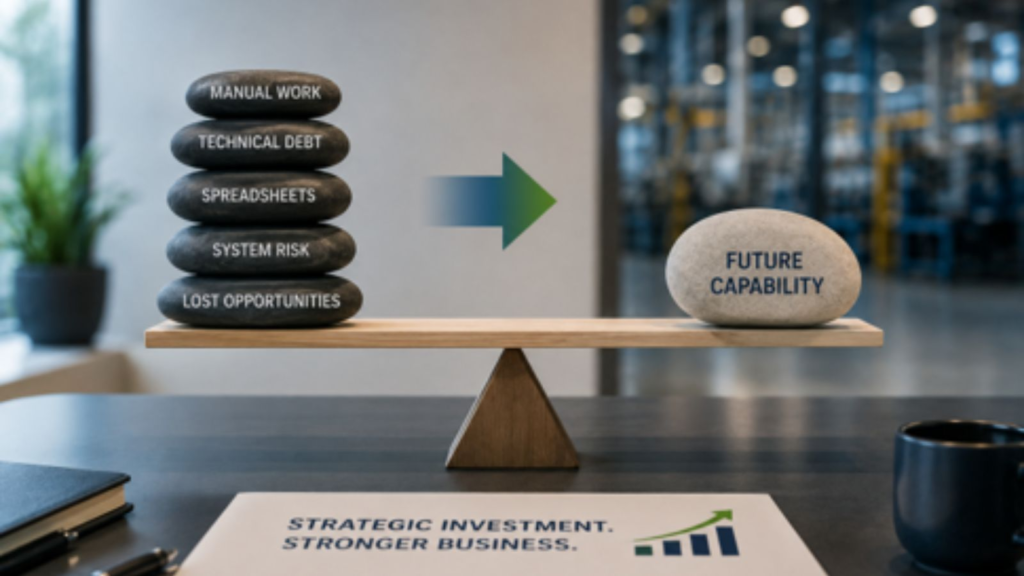
The true modernization decision weighs the accumulated cost and risk of the current environment against the future capabilities the business needs to grow.
What Business Benefits Should Executives Evaluate?
The other mistake I see is trying to justify modernization through a long list of software features.
Executives do not invest in features.
They invest in outcomes.
For a manufacturing organization, several capabilities deserve consideration.
Operational Visibility
How quickly can leadership understand what is happening across finance, inventory, purchasing, production, sales, and operations?
Better visibility can shorten the distance between an operational event and a management decision.
Scalability
Can the current environment comfortably support the company’s growth plans?
Consider additional users, locations, entities, products, transactions, acquisitions, and operational complexity.
Scalability is not simply system performance. It is the ability to grow without multiplying administrative effort and workarounds.
Better Analytics and Power BI
Modern ERP should help the organization move from collecting data to using it.
Microsoft Power BI can support richer visualization and analysis of business information. But the value is not the dashboard itself.
The value is whether managers can identify issues sooner, ask better questions, and make decisions with greater confidence.
AI Readiness and Copilot
AI deserves a measured conversation.
I would never recommend an ERP modernization project simply because AI is fashionable.
But executives should consider whether their technology and data foundation will allow the organization to take advantage of emerging capabilities over the next several years.
Microsoft continues to integrate Copilot and AI capabilities across its business applications. The strategic question is not, “How much AI can we use tomorrow?”
It is:
“Are we creating a platform and data environment that gives us options tomorrow?”
Better Decision-Making
Ultimately, many of these benefits converge here.
Better connected information, less manual reconciliation, improved visibility, stronger reporting, and a more modern technology foundation should help people make better decisions.
If they do not, ask what business value the investment is actually creating.
How Should Manufacturers Think About ERP ROI?
ERP ROI is often oversimplified into a calculation:
Benefits minus costs divided by costs.
That calculation can be useful, but manufacturing ERP ROI is rarely captured by one number.
Some benefits are straightforward to quantify:
- Hours eliminated from manual reporting
- Infrastructure costs reduced
- Third-party applications retired
- Maintenance effort reduced
- Inventory improvements
- Faster financial reporting
- Lower administrative effort
- Reduced duplicate entry
Others require more careful assumptions:
- Better planning
- Improved operational visibility
- Faster decisions
- Greater scalability
- Reduced key-person dependency
- Easier integration
- Improved ability to support acquisitions or new locations
- Future AI and automation opportunities
And some benefits are strategic rather than immediately financial.
A CFO should absolutely challenge the assumptions. That’s healthy.
What I would avoid is assigning exaggerated dollar values to every possible benefit just to make the spreadsheet produce an attractive payback period.
A conservative business case that leadership trusts is much more useful than an aggressive ROI model nobody believes.
How Do You Build an Executive Business Case for Business Central?
I recommend building the case around five questions.
1. What Is the Business Trying to Achieve?
Start with strategy.
Are you growing? Acquiring? Adding facilities? Expanding product lines? Improving margins? Standardizing processes? Increasing visibility? Reducing manual effort?
If modernization is not connected to strategic priorities, the proposal will always feel like an IT expense.
As I discussed in our earlier article on planning a Dynamics GP to Business Central migration, successful modernization starts by establishing the business objectives, executive alignment, and future-state priorities that should guide the project.
2. What Does the Current Environment Really Cost?
Build a realistic baseline.
Include infrastructure, support, customizations, integrations, manual effort, reporting, third-party systems, technical debt, and internal resources.
3. What Risks Are We Carrying?
Evaluate key-person dependency, aging integrations, unsupported processes, security exposure, data quality, scalability, and operational fragility.
Not every risk needs a dollar value.
It does need to be visible.
4. What Capabilities Would Modernization Create?
Connect each proposed benefit to a business requirement.
Instead of saying “Power BI,” say “faster access to margin and operational performance information.”
Instead of saying “Copilot,” discuss where automation or AI-assisted processes may eventually reduce effort or improve responsiveness.
5. How Will We Measure Success?
Agree on outcomes before implementation.
That might include reporting cycle time, manual hours, inventory accuracy, process adoption, system availability, number of retired workarounds, or other KPIs relevant to your operation.
“If you can’t describe what should be better after modernization, you aren’t ready to calculate the ROI.” – Andrew Good
What Does Delaying Modernization Really Cost?
I have seen a version of this story more than once.
A manufacturer knows its ERP environment is becoming increasingly difficult to maintain. Reporting requires spreadsheets. A few integrations are fragile. Customizations are poorly documented. Several experienced employees know how to work around the system’s limitations.
Leadership discusses modernization.
The project is postponed.
Nothing dramatic happens.
That can reinforce the belief that postponement was the right decision.
Then the business changes.
Perhaps the company acquires another operation. A key employee leaves. A customer requires better information. A reporting requirement becomes more complex. An integration fails. Growth puts pressure on a manual process that worked perfectly well at a smaller scale.
Suddenly, the organization is trying to modernize under pressure.
The cost has not increased because GP suddenly became unusable.
It has increased because the company lost the luxury of choosing the timing.
That distinction matters.
ERP modernization is easier to manage as a strategic initiative than as an emergency response.
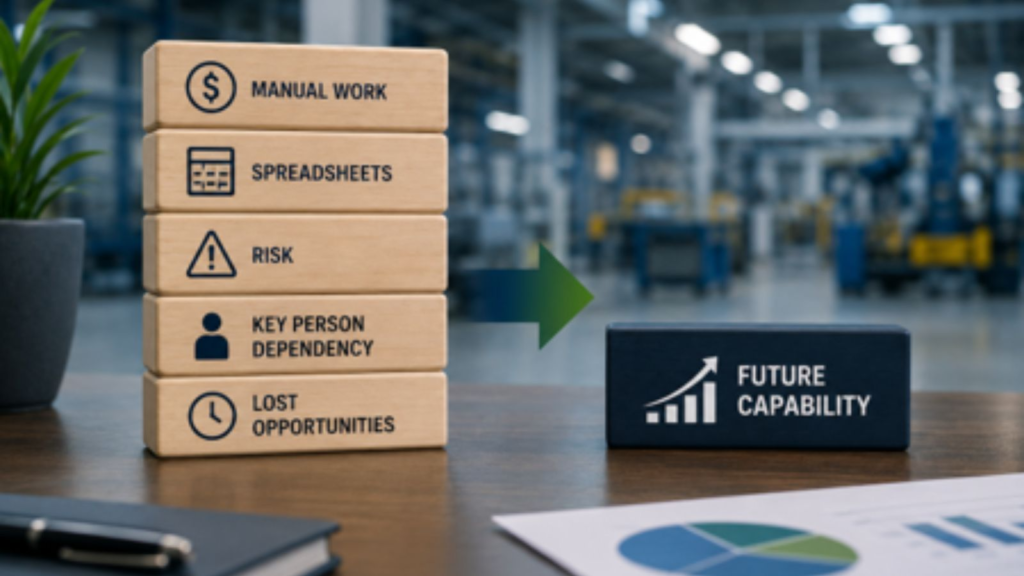
The cost of delay is not limited to maintaining legacy technology. It can also restrict the capabilities a manufacturer needs for future growth.
I am not suggesting every manufacturer should migrate immediately.
I am suggesting that delay should be an intentional business decision, supported by the same level of analysis as the decision to proceed.
What Should Leadership Evaluate Before Approving ERP Modernization?
Here is the executive framework I would use.
Strategic Fit: Does modernization support the company’s three-to-five-year strategy?
Current-State Cost: Do we understand the full cost of maintaining GP, including internal labor and workarounds?
Risk: What operational, technology, security, data, and people dependencies are we carrying?
Future Capability: What will BC enable that is difficult or impractical today?
Financial Case: What are the implementation costs, ongoing costs, quantifiable savings, and reasonable value assumptions?
Organizational Readiness: Do we have leadership sponsorship, process ownership, data readiness, and internal capacity?
Measurement: What KPIs will tell us whether the investment is delivering value?
Timing: What happens if we wait one year? Three years? Five?
That last question is important.
The decision is not simply to migrate or not to migrate.
It is also when, why, and under what conditions.
Executive Takeaways
For CEOs, CFOs, COOs, boards, and investors evaluating an ERP modernization strategy, I leave you with five principles.
First, don’t justify modernization because GP is old. Justify it because the business needs capabilities the current environment cannot efficiently provide.
Second, compare investment against the real cost of the status quo. Doing nothing has a cost, even when that cost is difficult to see.
Third, be conservative with ERP ROI. Quantify what you reasonably can and identify strategic benefits separately.
Fourth, connect technology capabilities to business outcomes. Power BI, Copilot, cloud technology, and automation only matter when they solve meaningful business problems.
Fifth, evaluate the cost of delay. Postponement may be entirely appropriate, but it should be an informed strategic choice.
Invest in Capability, Not Just Technology
A strong business case should give leadership confidence in both the decision and the path forward.
At Liberty Grove Software, our Executive ERP Modernization Assessment helps manufacturing leadership teams evaluate the current Dynamics GP environment, business priorities, operational constraints, risks, modernization opportunities, and readiness for Business Central.
The objective is not to convince every manufacturer to migrate.
It is to help executives answer a more useful question:
What ERP strategy best supports where our business is going?
If your leadership team is evaluating the future of Dynamics GP, we can help you build an objective modernization case grounded in business outcomes, risk, cost, and future capability.
Schedule Your Executive ERP Modernization Assessment
Final Thoughts
In our previous article, “What Data Should Manufacturers Migrate from Dynamics GP to Business Central”, we looked at what data manufacturers should bring forward from Dynamics GP and what should remain behind. The underlying principle was simple: migration should preserve business value, not historical clutter.
The business case requires the same discipline.
Modernization should not be approved because a new ERP looks impressive in a demonstration. Nor should it be rejected simply because the existing ERP can still process transactions.
The real question is whether your current environment can support the business you intend to become, at an acceptable cost and level of risk.
That’s a conversation worth having before circumstances decide for you.
“Modernization is not an investment in newer software. It is an investment in future capability.” – Andrew Good
In the next and final article in this phase of the series, “What Does a Successful Dynamics GP Migration Look Like?”, I’ll examine what successful manufacturers consistently do differently before, during, and after implementation.
We’ll look beyond timelines and go-live dates to leadership, governance, testing, training, change management, hypercare, KPIs, and business outcomes. That reflects the brief’s central message for Blog 9: successful ERP migrations should be measured by business outcomes, not simply by whether the system went live on schedule.
Because approving the investment is important.
Realizing its value is what matters.
Frequently Asked Questions
Build the case around business outcomes rather than software replacement. Identify the limitations and total costs of the current environment, quantify credible efficiency gains, evaluate risk, define future capabilities, and connect modernization directly to the organization’s strategic priorities.
ERP ROI compares the financial and operational value created by an ERP investment with its total cost. It can include measurable savings, such as reduced manual effort and infrastructure costs, as well as improvements in reporting, inventory management, productivity, scalability, risk management, and decision-making.
Potential hidden costs include technical debt, manual processes, spreadsheet-dependent reporting, aging infrastructure, cybersecurity requirements, employee dependency, maintaining customizations and integrations, and increasing difficulty finding specialized legacy ERP expertise.
CFOs should establish the current-state cost baseline, identify implementation and ongoing costs, quantify defensible benefits, assess business and technology risks, consider the cost of delay, and establish measurable outcomes. Strategic benefits that cannot reasonably be monetized should be identified separately rather than inflated to improve the ROI calculation.
That depends on the organization’s requirements, current Dynamics GP environment, strategic direction, operational complexity, costs, and readiness. Business Central should be evaluated against specific business outcomes rather than assumed to be the right answer simply because it is a newer platform.
Depending on the organization, potential benefits can include improved operational visibility, more connected information, less manual work, better reporting and analytics, scalability, reduced technology complexity, stronger integration opportunities, and a foundation for future automation and AI capabilities.
Start by documenting the full cost of implementation and ongoing operation. Then identify measurable benefits such as reduced manual labor, retired systems, infrastructure savings, faster reporting, improved inventory performance, and process efficiencies. Keep assumptions conservative and distinguish measurable returns from broader strategic benefits.
Leadership should understand why modernization is needed, what the current environment truly costs, what risks exist, which future capabilities matter, how much the initiative will cost, whether the organization is ready, how success will be measured, and what the consequences of delaying the decision are.
About Andrew Good

Andrew Good, CEO, Liberty Grove Software
Andrew Good, CEO of Liberty Grove Software, a leader in digital transformation, directs the company with strategic insights that deliver impactful results. With over two decades of expertise in Microsoft technologies, Andrew has guided businesses through digital transformation across manufacturing, finance, and healthcare.
Andrew's extensive knowledge comes from personal experiences with various companies. His hands-on operational knowledge comes from Engineering, Maintenance, and operational roles at Unilever and Sony Music. Fourteen years of working with Microsoft Dynamics BC/NAV follows successful projects in ERP, Computerized Maintenance Management Systems (EAM), and quality systems.
His passion for technology is matched by his love for sailing, which inspires his leadership. Andrew parallels the precision of navigating the seas and the challenges of steering a successful company. Under his leadership, Liberty Grove Software thrives, offering tailored solutions to empower clients and optimize operations with innovative Microsoft-based systems.